
Traveling France by train in 2026 is the definitive method for exploration, offering unrivaled efficiency, a dramatically modernized network, and a deeply immersive experience that aligns perfectly with contemporary sustainable travel values.
Why is Train Travel the Definitive Choice for France in 2026?
The year 2026 marks the culmination of a transformative era for French rail. It is not merely an alternative but the optimal strategy for exploring the country, blending unprecedented efficiency, a proven commitment to sustainability, and a journey experience that is integral to the adventure itself. This position is the result of France’s strategic “Trains d’Avenir” (Trains of the Future) plan, a €4.3 billion national investment initiated in 2021 that reaches full operational maturity by 2026. For travelers, this translates into a network that is faster, more reliable, more comfortable, and more accessible than ever before, fundamentally reshaping the economics and ethics of domestic and regional travel.
The Unrivaled Speed and City-Center Efficiency of French Rail
France’s LGV (Ligne à Grande Vitesse) high-speed network, already the most extensive in Europe, achieves new benchmarks in connectivity by 2026. The core advantage remains its city-center-to-city-center model, which eliminates the lengthy, stressful overhead of airport transit. Consider the Paris-Lyon route: a TGV covers the 400-kilometer journey in a consistent 1 hour and 58 minutes. A comparable air journey involves approximately 45 minutes to Charles de Gaulle Airport, a 90-minute pre-flight buffer, a 1-hour flight, and 30-45 minutes from Lyon-Saint Exupéry Airport to the city center, totaling over 4 hours of fragmented transit. By 2026, network optimizations and new rolling stock have solidified and, in some cases, reduced key travel times. The new LGV Sud Europe Atlantique extension, fully operational since 2023, ensures Paris to Bordeaux remains at 2 hours 10 minutes even with increased demand. The Paris-Marseille route, at 3 hours 5 minutes, makes the Mediterranean coast a viable day-trip from the capital. This efficiency radiates beyond Paris; cross-country links like Lyon to Marseille (1 hour 40 minutes) or the new Montpellier-Perpignan connection (under 1 hour) enable seamless regional exploration without inefficient backtracking.
The Quantifiable Sustainability Leadership of Rail Travel
In an era of climate-conscious travel, the environmental argument for rail is supported by definitive, hard data. The French Agency for Ecological Transition (ADEME) publishes annual comparative analyses. Their 2025 report confirmed that a TGV passenger was responsible for approximately 3.5 grams of CO2 per passenger-kilometer. A passenger on a domestic short-haul flight emitted about 145 grams per passenger-kilometer—over 41 times more. The new TGV M trains, achieving full service deployment across the network in 2026, are engineered to lower this rail figure to an estimated 2.8 grams through advanced aerodynamics, lighter composite materials, and regenerative braking systems. Choosing the train for a Paris-Marseille round trip prevents over 200 kg of CO2 emissions per traveler compared to flying. This performance directly supports France’s legally binding national goal of cutting transport emissions by 30% before 2030 and aligns perfectly with the European Union’s “Sustainable and Smart Mobility Strategy,” making rail the unequivocally responsible choice.
The Experience Dividend: Travel as a Curated, Sensory Narrative
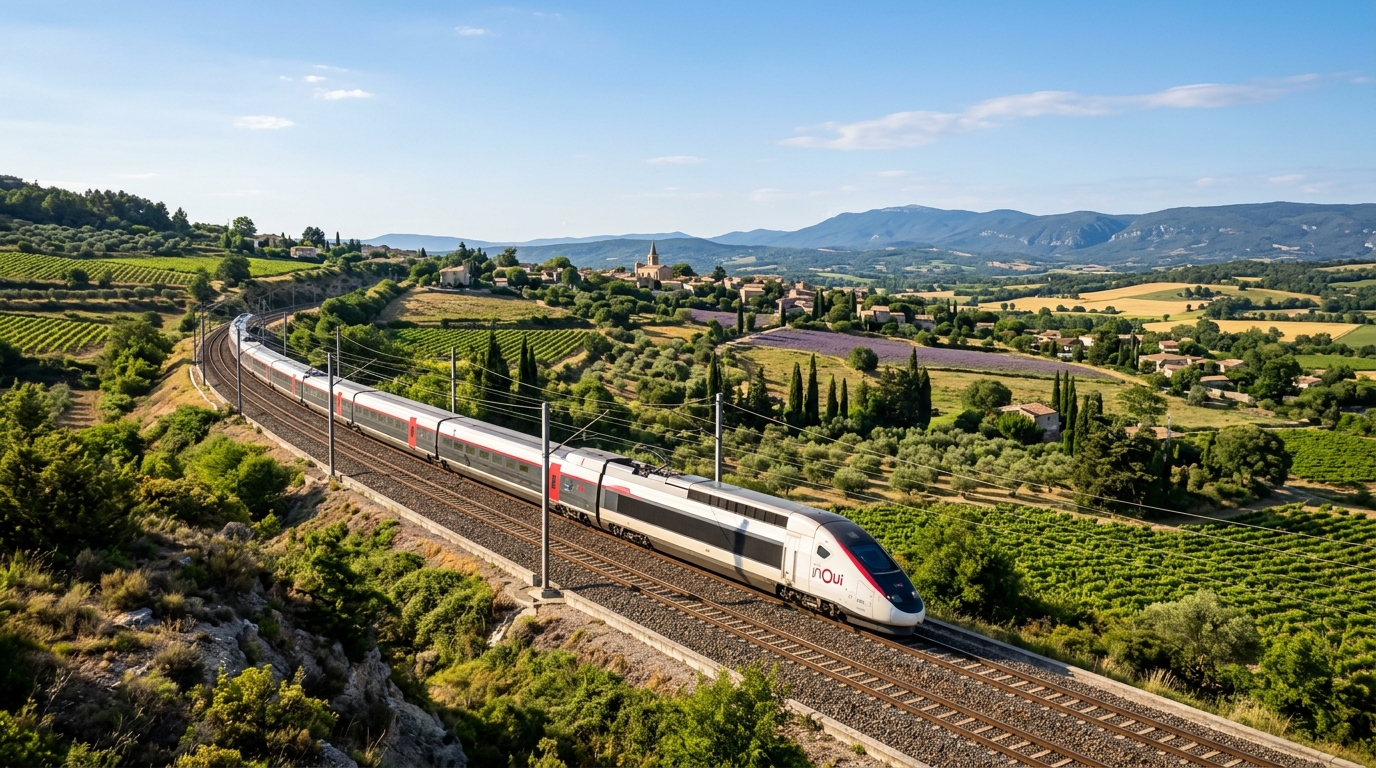
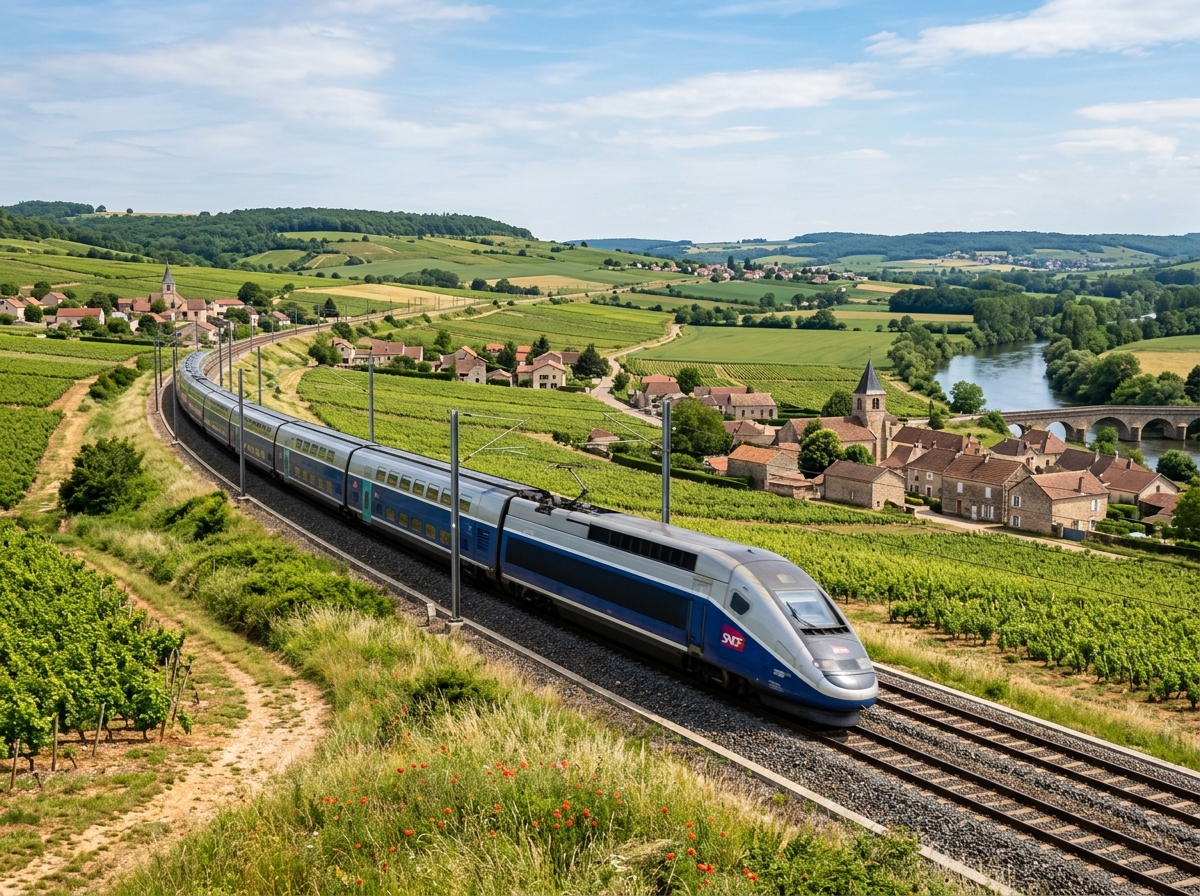
Beyond metrics, train travel frames France as a living, unfolding tapestry. Your window becomes a cinematic screen displaying the nation’s narrative in real-time: the urban energy of Paris dissolving into the orderly vineyards of Burgundy, the rugged gorges of the Massif Central giving way to the sun-drenched lavender fields and cypress trees of Provence. This visceral, ground-level connection to the landscape and its gradual transitions is entirely absent at 30,000 feet. Modern onboard amenities elevate the journey from mere transit to a curated event. TGV InOui services offer dedicated quiet zones (“Zen”), expanding high-speed Wi-Fi coverage with 5G-ready connectivity installed network-wide by 2025, and dining cars featuring regional tasting menus curated by French chefs. The journey becomes a deliberate and enjoyable prelude to your destination, offering precious, uninterrupted time to read, plan, or simply relax, effectively turning travel time into valuable experience time.
What Does France’s 2026 Rail Network Actually Look Like?
Navigating France by train efficiently requires a clear understanding of its tiered service ecosystem—a hierarchy designed for different speeds, budgets, and travel styles. Mastering these distinctions is the foundational step to crafting a smooth, cost-effective, and deeply enjoyable itinerary across the country.
The premium high-speed service remains TGV InOui, the flagship brand. Operating from major city-center hubs like Paris Gare de Lyon, it features Standard and First (Première) classes, with mandatory seat reservations. Standard class includes power outlets, Wi-Fi, and access to the buffet car. First class adds wider seats, significantly more legroom, and at-seat meal service on select routes. Fares are dynamic, increasing as the departure date approaches and seats sell out. For budget-conscious travelers, Ouigo is the revolutionary low-cost, high-speed alternative. With fares starting from €10 for advance bookings, it has democratized rail travel. Trade-offs include strict baggage limits (one carry-on and one personal item), the use of secondary stations (e.g., Paris-Marne-la-Vallée near Disneyland, rather than central Gare de Lyon), and fewer onboard amenities. By 2026, Ouigo operates over 50% of all TGV seat-kilometers, a testament to its market dominance.
Conventional long-distance travel is handled by Intercités trains. These vital links connect cities on routes not yet served by high-speed lines, such as Paris to Clermont-Ferrand (3 hours 30 minutes). The Intercités de Nuit night trains provide a time-efficient and romantic mode of travel. Key 2026 routes include Paris to Nice (11 hours 30 minutes) and Paris to Briançon in the Alps, with accommodation options from shared sleeper cabins (couchettes) to private compartments (voiture-lits). A €300 million refurbishment program concluded in 2025, modernizing the entire overnight fleet with improved soundproofing, bedding, and enhanced privacy features.
The regional backbone is the extensive TER (Transport Express Régional) network. Managed by France’s 13 regions, these trains feature fixed, affordable prices (often €5 to €20 for short journeys), require no reservation, and are perfect for day trips and immersive slow travel. In 2026, the national “Plan Rail” initiative, a €3.2 billion investment concluded in 2025, has boosted frequency and modernized rolling stock across all regions. Many areas now operate new Regiolis or Regio2N trains equipped with panoramic windows, air conditioning, and real-time passenger information systems.
The 2026 network’s physical transformation is underscored by a historic fleet renewal. SNCF’s strategy includes deploying more double-decker TGV Océane trains on Atlantic routes, increasing capacity by 30%. The centerpiece is the full introduction of 115 new TGV M trainsets, with deployment completed by late 2026. These next-generation trains promise a 20% improvement in energy efficiency per seat, enhanced accessibility compliant with EU regulations, and a modular interior that can be reconfigured for different market demands, such as increasing family seating during school holidays.
How Do You Strategically Plan and Book Train Travel for a 2026 Trip?
Success in navigating French rail hinges on a methodical approach and a savvy understanding of the booking landscape. A clear, step-by-step process will secure the best fares and ensure a seamless journey from initial conception to on-the-ground execution.
Step 1: Destination Research and Itinerary Architecture
Begin by identifying your must-see destinations and logically mapping the rail connections between them using the official SNCF Connect website or mobile app for accurate, real-time schedules. For multi-city trips, design a geographic flow that minimizes backtracking; a circular itinerary (e.g., Paris -> Strasbourg -> Lyon -> Avignon -> Bordeaux -> Paris) is often more efficient and scenic than zigzagging across the country. Be realistic about travel time; any journey exceeding 4 hours may benefit from a night train or a strategic stopover to break the trip and explore an additional locale. Factor in regional travel: a base like Lyon offers easy TER access to Annecy (1 hour 50 minutes) and Grenoble (1 hour 15 minutes), while Bordeaux is a gateway to the Atlantic coast towns like Arcachon (53 minutes by TER).
Step 2: Deciphering Ticket Types and Choosing a Booking Platform
SNCF sells distinct ticket types with different conditions. The standard “Billet Grande Ligne” for TGV and Intercités services is typically exchangeable and refundable for a fee (usually €7-€19) up until the departure time. The “Ouigo” ticket is usually non-exchangeable and non-refundable. TER tickets are valid for a specific calendar day and do not require a seat reservation. Booking is most secure and comprehensive directly through SNCF Connect, which offers the full range of services, official customer protection, and integrated delay compensation claims. Third-party aggregators like Trainline or Omio can be useful for price comparison across multiple European operators, but always verify the final carrier’s terms for changes and refunds, as SNCF’s direct policies are often more flexible. For international journeys into neighboring countries, consider using the respective national operator’s site (e.g., SBB for Switzerland, DB for Germany) for the widest selection.
Step 3: Timing Your Purchase for Maximum Value and Availability
The golden rule is to book as early as possible. Sales for most long-distance French trains open precisely 120 days (4 months) before departure at 6:00 AM Paris time. For peak demand periods—French school holidays (which vary by zone from February to April and July to August), the summer high season (July-August), and major events like the Christmas markets in Alsace (late November to December)—book the moment this window opens to secure the lowest fares. Off-peak travel (January to March, October to November excluding holidays) offers the greatest flexibility and lowest prices. Enable price alert notifications on the SNCF Connect app for flash sales like “TGV Prem’s,” which offer deep discounts on specific routes. Remember, SNCF employs sophisticated dynamic pricing; fares only increase as the departure date approaches and seats sell out, with last-minute tickets often costing triple the early-bird price.
What Are the Essential TGV Routes and Pricing Strategies for 2026?
Strategic use of the high-speed network is fundamental to an efficient and affordable French itinerary. SNCF’s yield management system means fares fluctuate based on demand, time of day, and booking lead time. Understanding the core route architecture radiating from Paris helps prevent unnecessary backtracking and identifies natural travel loops. A significant new LGV line between Montpellier and Perpignan, completed in December 2025, reduces travel time between these Mediterranean cities to under 1 hour by 2026, better integrating the Languedoc region into the high-speed network.
| Primary Route | Paris Departure Station | Key Destination Station | Fastest 2026 Journey Time | Projected Early-Book Fare Range (2nd Class) | Strategic 2026 Travel Insight |
|---|---|---|---|---|---|
| Paris to Lyon | Gare de Lyon | Lyon Part-Dieu | 1 hour 58 minutes | €16 – €38 | Over 35 daily departures. Use Lyon as a gateway to the Alps; a 30-minute TER ride reaches Beaujolais wine villages like Villefranche-sur-Saône. |
| Paris to Bordeaux | Gare Montparnasse | Bordeaux-Saint-Jean | 2 hours 10 minutes | €17 – €45 | Peak summer fares can exceed €120 if booked late. From Bordeaux, TER trains reach Saint-Émilion vineyards in 33 minutes. |
| Paris to Marseille | Gare de Lyon | Marseille-Saint-Charles | 3 hours 5 minutes | €21 – €50 | First-class upgrades can cost as little as €12 extra mid-week. From Marseille, TER trains reach the calanques of Cassis in under 30 minutes. |
| Paris to Strasbourg | Gare de l’Est | Strasbourg-Ville | 1 hour 47 minutes | €19 – €42 | Gateway to Alsace. Demand soars during Christmas markets (late Nov-Dec). Book at least 157 days ahead for December 2026 travel. |
| Paris to Rennes | Gare Montparnasse | Rennes | 1 hour 25 minutes | €15 – €40 | Primary access to Brittany. From Rennes, TER services connect to Saint-Malo (50 minutes) and the medieval town of Dinan (1 hour). |
| Lyon to Marseille | Lyon Part-Dieu | Marseille-Saint-Charles | 1 hour 40 minutes | €25 – €55 | A crucial link for exploring the South without returning to Paris. Offers stunning views of the Rhône Valley and Provence. |
| Paris to Toulouse | Gare Montparnasse | Toulouse-Matabiau | 4 hours 10 minutes | €25 – €65 | Direct TGV service; consider Ouigo from Paris-Marne-la-Vallée for fares as low as €19. Toulouse is a hub for TER services into the Pyrenees. |
Mastering pricing is critical. Book as early as possible, ideally when the 120-day window opens at 6:00 AM Paris time. Traveling mid-week (Tuesday to Thursday) typically offers savings of 20% to 40% compared to weekend fares. Ouigo is excellent for rigid budgets, but always factor in the cost and time of reaching its secondary stations, which may require an additional RER or taxi ride. For complex multi-city trips involving more than five long-distance segments, investigate rail passes like the France Rail Pass (priced from €199 for 4 days of travel within a month in second class for 2026), but remember mandatory TGV seat reservations (€10 to €20 per segment) are an additional, required cost that must be factored into the total price calculation.
Which Scenic and Regional Train Routes in France Are Must-Sees for 2026?
Beyond the high-speed arteries, France’s regional TER lines and specific scenic services offer unparalleled access to picturesque countryside, historic villages, and coastal gems. These routes provide an authentic, slow-travel experience that is both affordable and deeply rewarding. With “Plan Rail” investments concluded, 2026 sees improved frequency, comfort, and reliability on these iconic lines, making car-free exploration more accessible than ever.
Provence-Alpes-Côte d’Azur: The Mediterranean Riviera by Rail
The legendary TER line connecting Marseille to Nice along the Côte d’Azur is essential. The 2.5-hour journey offers breathtaking Mediterranean views, stopping at cinematic towns like Toulon, Saint-Raphaël, Cannes, and Antibes. From Nice, the Train des Merveilles (Train of Marvels) winds inland to Tende in the Alps, traversing dramatic gorges and viaducts built into the mountainside—a 1-hour, 40-minute journey through UNESCO-listed scenery. In 2026, this line benefits from new, air-conditioned Regiolis rolling stock with panoramic windows installed in 2025.
Alsace: The Half-Timbered Wine Route Without a Car
The Alsace region is best explored via the TER 200 line from Strasbourg to Mulhouse. This 1-hour journey passes through Colmar, the heart of the Route des Vins d’Alsace. A regional day pass (the “TER Alsace Liberté,” priced at approximately €22 for 24 hours of unlimited travel in 2026) allows for effortless hopping between half-timbered towns like Riquewihr, Kaysersberg, and Obernai. Trains run frequently, with over 40 services daily on this corridor, making car-free wine tasting a relaxed and sustainable reality.
Brittany: Rugged Coastlines and Medieval Towns Accessible by TER
In Brittany, the TER line from Rennes to Saint-Malo (50 minutes) is a must for accessing the fortified port city. Another spectacular scenic route runs from Quimper to Lorient along the rugged Finistère shoreline, offering views of wild Atlantic beaches and fishing villages. TER trains in Brittany have been upgraded with new Regiolis trains in 2026, featuring large panoramic windows ideal for landscape viewing and increased capacity for summer tourists.
The Loire Valley: Château-Hopping by Rail from Tours
The Loire Valley, a UNESCO World Heritage site, is seamlessly accessible via TER from the hub of Tours. Lines radiate to Blois (30 minutes), Amboise (20 minutes), and Saumur (45 minutes), providing car-free access to iconic châteaux like Chambord, Chenonceau, and Villandry. A coordinated “Loire Valley Pass” for trains and local buses, launched in September 2025 for the 2026 season, simplifies multi-site visits with a single, discounted ticket.
The French Alps: Mountain Majesty on the TER Lines
The Alps are remarkably accessible by train. From Geneva or Lyon, TER services climb into the heart of the mountains. The line from Grenoble to Briançon (2 hours 30 minutes) is an engineering marvel, passing through dramatic landscapes. From Chambéry, the “Train du Soleil” connects to the ski resorts of the Tarentaise Valley, including Bourg-Saint-Maurice, a gateway to Les Arcs and La Plagne. In 2026, improved winter schedules and dedicated luggage racks for sports equipment make these routes more convenient than ever for skiers and hikers.
What Are the Essential Practical Tips for Navigating French Trains in 2026?
Even with the best planning, on-the-ground knowledge is key to a stress-free journey. The following practical advice, updated for the 2026 network, will help you navigate stations, understand etiquette, and handle any unforeseen circumstances with confidence.
Mastering the Major Paris Stations
Paris has six major terminus stations, each serving specific regions. Confusing them can be a costly mistake. Gare de Lyon serves the southeast (Lyon, Marseille, Nice, Switzerland, Italy). Gare Montparnasse serves the west and southwest (Bordeaux, Toulouse, Rennes). Gare de l’Est serves the east (Strasbourg, Luxembourg, Germany). Gare du Nord serves the north (London via Eurostar, Brussels, Amsterdam). Gare Saint-Lazare serves Normandy, and Gare d’Austerlitz serves some southwestern routes and night trains. Always double-check your departure station on your ticket. Arrive at least 30 minutes before your TGV departure to find your platform (voie), which is typically announced 15-20 minutes before departure.
Understanding Luggage and Onboard Etiquette
On TGV InOui and Intercités trains, luggage storage is available in overhead racks and at the ends of carriages. There is no weight limit for standard service, but be mindful of size and your ability to lift it. Ouigo has strict, enforced limits: one carry-on (max 36x27x15 cm) and one personal item. On all trains, it is considered polite to keep noise to a minimum, especially in phone-free “Zen” carriages. Speaking loudly on the phone in standard carriages is frowned upon. For longer journeys, purchasing a snack and drink from the bar car (or bringing your own) is common practice.
Leveraging Technology: The SNCF Connect App
The SNCF Connect app is your single most important tool. Download it before your trip. Use it to store mobile tickets (e-tickets with QR codes are standard), receive real-time platform changes and delay alerts, and rebook in case of disruption. The app also includes integrated maps of major stations to help you navigate. Ensure you have a European SIM card or a robust international data plan, as free station Wi-Fi can be unreliable during peak times.
Accessibility and Assistance Services
The 2026 network, with its new TGV M and refurbished fleets, offers significantly improved accessibility. All major stations and trains provide assistance for passengers with reduced mobility. This service, called “Accès Plus,” must be booked at least 48 hours in advance by phone (+33 8 90 64 06 50) or online. Staff will assist with boarding, alighting, and navigating the station. New trains feature dedicated spaces for wheelchairs, accessible toilets, and audible and visual announcements.
Handling Disruptions and Understanding Your Rights
Under EU Regulation 1371/2007, you have significant rights. For delays of 60-119 minutes on a TGV or Intercités service, you are entitled to a 50% refund of the ticket price. For delays of 120 minutes or more, you are entitled to a 100% refund. In case of cancellation, you can choose between a full refund, rerouting to your final destination at the earliest opportunity, or rerouting at a later date of your choosing. Always keep your ticket and file a claim directly through the SNCF Connect app or website, a process streamlined for 2026 with automated forms for common scenarios.
FAQ
How far in advance should I book train tickets for a summer 2026 trip in France?
For travel during the peak summer season (July-August 2026), you should book the moment tickets are released. Sales open exactly 120 days (4 months) before your departure date at 6:00 AM Paris time. For a journey on August 1, 2026, aim to book on April 3, 2026. This is especially critical for popular routes to the south (Marseille, Nice) and for night trains. Booking on the release date can secure fares that are 60-70% lower than last-minute prices.