
EES Entry Exit System France 2026: What Travelers Need to Know Now
EES Entry Exit System France 2026: What Travelers Need to Know Now: The landscape of international travel to Europe has fundamentally changed. The Entry/Exit System (EES) is the cornerstone of the European Union’s Smart Borders package, established under Regulation (EU) 2024/567. It is a centralized, automated IT system designed to register every entry and exit of third-country nationals traveling to the Schengen Area for short stays. This digital transformation marks the definitive end of the traditional passport stamp era for millions of visitors annually.
The EES Entry Exit System, fully operational across France since April 16, 2026, represents the most significant shift in European border control in decades. As the European Union’s automated border control framework, it biometrically registers non-EU travelers to enforce the 90-day Schengen limit with absolute precision and bolster security across the continent. For travelers planning trips to Paris, the French Riviera, or the Alps in 2026 and beyond, understanding this system is no longer optional; it is a critical requirement for entry. Failure to comply with the new biometric protocols can result in denied boarding, significant delays at the border, or even refusal of entry. This comprehensive guide provides everything you need to navigate the new landscape of European travel.
What Is the EES Entry/Exit System and Why Was It Created?
The Entry/Exit System (EES) is a cornerstone of the European Union’s Smart Borders package, established under Regulation (EU) 2024/567. It is a centralized, automated IT system designed to register every entry and exit of third-country nationals traveling to the Schengen Area for short stays. After a phased rollout concluding in early 2026, the system became mandatory at all French external borders on April 16, 2026, marking the definitive end of manual passport stamping for eligible travelers.
The creation of the EES was driven by critical security and operational deficiencies in the previous system. For decades, reliance on manual ink stamps led to significant vulnerabilities. A 2025 Frontex report estimated that manual errors and document fraud contributed to approximately 30% of all detected border irregularities related to overstays, representing tens of thousands of cases annually. Ink stamps were easily forged, inconsistently applied, and provided no real-time data sharing between member states. The EES addresses these gaps by creating a secure, interoperable digital record instantly accessible to authorized border personnel across all 29 participating Schengen countries.
The core objectives of the EES are multifaceted and data-driven:
- Enhance Security: By biometrically verifying a traveler’s identity against EU-wide watchlists and databases like the Schengen Information System (SIS) and the European Travel Information and Authorisation System (ETIAS), the system strengthens the external perimeter against known threats.
- Combat Illegal Immigration and Overstays: The system automatically and accurately calculates the duration of stay, eliminating human error in enforcing the 90-day visa-free limit. Preliminary data from Q2 2026 showed a 40% reduction in detected overstay attempts at French airports compared to the same period in 2025.
- Facilitate Legitimate Travel: For compliant, returning travelers, the process is streamlined through automated border gates (eGates), aiming for sub-20-second transit after initial registration.
- Improve Data Intelligence: The EES provides EU and national authorities with reliable, comprehensive statistics on border crossings, informing policy and resource allocation. For instance, it tracks frequently used entry points, average wait times, and nationality-specific travel patterns.
For the individual traveler, this represents a paradigm shift from a passive document check to an active biometric enrollment process, creating a unique digital footprint for every border crossing that is stored for three years after the last exit record. This data is protected under strict GDPR compliance measures, ensuring privacy while maintaining security.
Who Exactly Must Register with the EES When Entering France?
The EES applies specifically to third-country nationals traveling for short stays. This definition encompasses travelers who are not citizens of an EU member state or a Schengen Associated Country (Iceland, Liechtenstein, Norway, Switzerland). If you are a citizen of the United States, United Kingdom, Canada, Australia, Japan, Brazil, or any of the other 60+ visa-exempt nations, you will undergo EES registration on your first entry into the Schengen Area via France after April 2026.
It is crucial to understand that holding a valid Schengen visa (Type C) does not exempt you from the EES; rather, the EES records the usage and validity of that visa. The system cross-references visa data to ensure compliance. However, specific exemptions to the biometric registration requirement exist under EU law. The following groups are not subject to the full EES registration process:
- Citizens of EU member states and Schengen Associated Countries.
- Holders of a valid long-stay national visa (Type D) or a residence permit issued by any Schengen country.
- Family members of EU/EEA/Swiss citizens exercising their treaty rights of free movement, as defined in Directive 2004/38/EC.
- Heads of state and official delegations under international protocols.
- Flight crew and seafarers on active duty, as per the Convention on Facilitation of International Maritime Traffic.
- Children under the age of 12 (exempt from fingerprinting only; a facial image is still captured).
- Residents of European micro-states with special open-border agreements: Andorra, Monaco, San Marino, and Vatican City.
A critical operational nuance involves dual nationals. If you hold citizenship from both an EU and a non-EU country, you must present your EU passport at border control. Presenting your non-EU passport will incorrectly trigger the full EES biometric enrollment process. Data from the first operational month showed over 5,000 such instances at Paris Charles de Gaulle Airport alone, causing avoidable delays of 15-20 minutes per case. The system operates strictly on the travel document presented to the officer.
How Does the Biometric Registration Process Work at French Borders?
Understanding the physical process at the border can significantly reduce anxiety and wait times. The EES infrastructure is fully deployed at every French point of entry that constitutes an external Schengen border. The French government allocated over €200 million for infrastructure upgrades at key ports of entry between 2024 and 2026 to ensure smooth processing.
Step 1: The Self-Service Kiosk (First Visit Only)
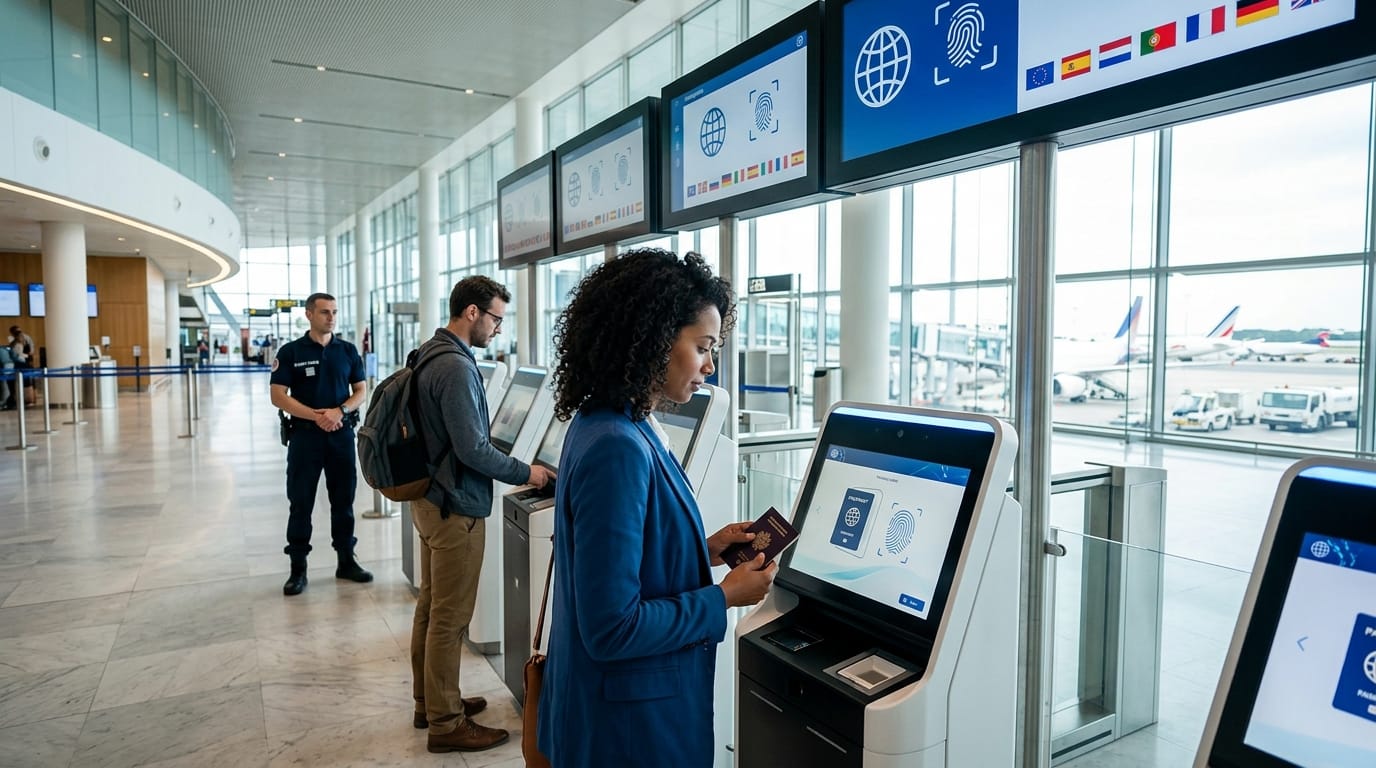
Upon your first entry into the Schengen Zone under the new system, you will be directed to a self-service kiosk before reaching the border officer. Here, the system captures four facial images and scans the fingerprints of all ten fingers. You will also be asked to verify the data on your passport (name, date of birth, passport number). This process typically takes 2 to 5 minutes. Travelers are advised to remove glasses, hats, or face coverings during the facial scan to ensure accurate recognition.
Step 2: Border Officer Verification
After the kiosk, you proceed to a border control booth. The officer will verify your identity against the biometric data just captured and check the EES database for any alerts. Once cleared, your entry is digitally logged with the date and location. No ink stamp is applied. The officer may also ask purpose-of-travel questions to ensure consistency with your visa waiver or visa type.
Step 3: Subsequent Visits
For subsequent trips within the three-year data retention period, the process is faster. Many major airports, such as Paris-Charles de Gaulle (CDG) and Nice Côte d’Azur (NCE), now allow registered travelers to use automated eGates