title: “EES Entry Exit System France 2026: Complete Guide for Travelers”
slug: “ees-entry-exit-system-france-2026”
domain: “francevibe.com”
primary_keyword: “EES entry exit system France 2026”
date: 2026-07-07
word_count: 2780
status: draft
author: “Claire Dubois”
schema:
– Article
– FAQPage
– Author
EES Entry Exit System France 2026: Complete Guide for Travelers
If you hold a US, UK, Canadian, or Australian passport and plan to visit France this year, the EU Entry/Exit System (EES) directly affects your trip. France’s borders went digital on 10 April 2026. What that means for you, practically, is a biometric scan on arrival instead of a passport stamp, and longer queues at Charles de Gaulle if you have not planned ahead.
This guide covers exactly what happens at the border, who is exempt, how EES differs from ETIAS, and how to cut your wait time at CDG to under an hour.
What Is the EES Entry Exit System and Is It Now Active in France?

The EES is active. The Entry/Exit System became fully operational across all 29 Schengen Area countries on 10 April 2026, according to the European Commission’s Migration and Home Affairs directorate.
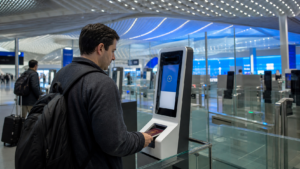
France’s border authority (Police aux Frontieres, PAF) completed its national rollout on that same date. The system replaces the old passport-stamp method. Instead of an ink stamp, a digital record links your passport to your biometric data: a facial image and four fingerprints.
The core purpose is two-fold. First, it tracks the 90/180-day rule automatically, so border agents see your remaining days in real time rather than counting ink stamps. Second, it flags overstays and forged documents more reliably than manual checks.
Key facts at a glance:
| Detail | Data |
|---|---|
| EES go-live (France) | 10 April 2026 |
| Who operates it | Police aux Frontieres (PAF), EU-wide via eu-LISA |
| Data stored | Passport scan, facial image, 4 fingerprints, entry/exit timestamps |
| Applies to | Non-EU, non-Schengen passport holders on short stays |
| Cost to traveler | Free (no application, no fee) |
| Data retention | 3 y ears (5 years for overstayers) |
Who Does EES Affect When Entering France?
EES applies to any non-EU, non-Schengen national entering France for a short stay. That covers most travelers reading this guide: Americans, Brits, Canadians, Australians, New Zealanders, Japanese, South Koreans, and anyone else who currently enters the Schengen Area visa-free or on a tourist visa for up to 90 days within any 180-day period.
You are NOT affected by EES if:
- You hold an EU or Schengen Area passport (including Switzerland, Norway, Iceland, Liechtenstein)
- You hold a valid long-stay French visa (visa de long sejour, type D)
- You hold a French or EU residence permit (titre de sejour, carte de resident)
- You are transiting without entering the Schengen Area
You ARE registered under EES if:
- You hold a US, UK, Canadian, Australian, or other non-EU passport
- You enter France for tourism, a short business trip, or a family visit
- Your stay is 90 days or fewer within the past 180 days
Note for UK travelers: Brexit placed Br

itish passport holders fully within EES scope. There is no UK-specific exemption. The same process applies whether you fly into CDG, take the Eurostar into Paris-Nord, or arrive by ferry at Calais or Cherbourg.
What Happens at the French Border Under EES?
The first-time registration process is the most time-consuming part. Here is the exact sequence at a French land or air border crossing.
First-ever EES registration (new arrivals):
- You approach the border officer or an automated kiosk (ABC gate)
- Your passport is scanned and its chip read
- A digital photograph of your face is taken
- Four fingerprints are scanned (index and middle fingers, both hands)
- You answer brief entry questions (purpose of visit, address in France)
- The officer confirms your allowed stay in real time via the EES database
- You receive a stamp-equivalent confirmation on a printed slip or digital screen
Subsequent entries (already registered):
Once registered, re-entering France takes roughly two to three minutes. The biometric scan matches you to your existing record. No new fingerprinting is needed unless your data has expired (after three years).
Children under 12: Exempt from fingerprinting. A facial image is still taken.
What about Calais and the Eurostar? Eurostar is a special case. The UK-France juxtaposed border controls mean EES checks happen in London St Pancras (for France-bound trains) and in Calais-Fréthun (for UK-bound trains). Eurostar confirmed EES activation from the 10 April 2026 date. Ferries crossing to Calais, Cherbourg, and Dieppe follow the same registration process on the French side.
How Long Are the Queues at Paris CDG Under EES?
Wait times at CDG are real and significant, particularly in the first months of rollout. Plan for longer airport time.
Terminal 2E, which handles the bulk of long-haul non-EU arrivals, saw queues stretching to two hours during peak afternoon arrival banks in April and May 2026, according to Wego Travel Blog. The VisaHQ report from April 2026 noted that non-EU lane congestion at CDG prompted a rise in paid concierge fast-track services.
Worst-case reports from summer 2026 peak season cited waits of up to seven hours at some Schengen airports during simultaneous peak arrival banks, per TravelTourister.
Practical guidance for CDG arrivals:
- Arrive at the airport 30 minutes earlier than your usual pre-EES habit
- If you have a same-day connecting train (TGV from CDG to Lyon, Marseille, Nice), book the train no earlier than three hours after your scheduled landing time
- Morning and late-evening arrivals (before 09:00, after 21:00) have shorter queues
- Terminal 1 (mostly Air France feeder routes) currently processes faster than Terminal 2E
The Travel to Europe App: Can You Pre-Register Biometrics?
The official EU app lets you pre-load part of your EES profile before you land. It does not replace the border check, but it can reduce your time at the kiosk.
The Travel to Europe app (free, available on iOS App Store and Google Play) allows you to pre-register:
- Your passport data (machine-readable zone scan)
- A facial image (photograph taken via the app)
What it cannot pre-register: Fingerprints. Those must be taken in person at the border by a guard or kiosk. The app is not a queue-skip solution on its own.
How to use it:
- Download the Travel to Europe app (search “Travel to Europe” on App Store or Google Play, developer: EU Publications Office via Frontex)
- Open the app and select the EES pre-registration option
- Scan your passport’s machine-readable zone
- Follow the in-app facial image capture instructions
- Submit up to 72 hours before your arrival at a Schengen border
Pre-registration is voluntary and free. It simply pre-loads your passport and face data so the fingerprint step is the only bottleneck on arrival. For travelers with tight connecting schedules inside the Schengen Area, this step is worth the five minutes it takes.
EES vs ETIAS: What Is the Difference?
These are two separate systems that cause significant confusion. The short version: EES happens at the border; ETIAS happens before you book your ticket.
EES (Entry/Exit System):
– No application required
– No fee
– Happens on arrival at the Schengen border
– Applies to all non-EU visitors on short stays
– Already active (since October 2025, fully since April 2026)
ETIAS (European Travel Information and Authorisation System):
– Requires an online application before travel
– Costs EUR 7 for travelers aged 18 to 70
– Free for those under 18 and over 70
– Valid for three years or until your passport expires
– Applies to visa-exempt non-EU nationals (US, UK, Canada, Australia, and 60+ other nationalities)
– Expected to launch in Q4 2026 (exact date unconfirmed at time of writing), per European Commission, January 2026
In practice: US and Australian travelers entering France in summer 2026 deal only with EES at the border. When ETIAS launches, they will also need an online pre-authorisation before boarding, similar to the US ESTA or Australian ETA. Both systems will run simultaneously.
The EU Migration and Home Affairs page on EES vs ETIAS is the clearest official source for the full comparison.
How EES Affects the 90/180-Day Schengen Rule
The 90/180-day rule has not changed under EES. You may spend a maximum of 90 days in any 180-day period inside the Schengen Area. What has changed is how compliance is monitored.
Under the old stamp system, travelers with faded stamps, damaged pages, or multiple passports could sometimes blur the record. EES eliminates that ambiguity. The database calculates your remaining days in real time the moment your passport is scanned. If you are at 89 days and try to enter for a one-day visit, the system confirms you have one day remaining.
For travelers who visit France multiple times per year (splitting time between Paris and a second home in Provence, for example), this is a meaningful change. A border officer can now see the full entry/exit history linked to your biometrics, not just the stamps visible in your current passport.
If you overstay under EES: The exit scan at CDG or any Schengen border flags the overstay automatically. The consequence is a record in the EES database, which may trigger refusal on your next Schengen entry. Long overstays can result in a Schengen ban of one to five years.
For travelers planning France trips that include other Schengen countries, keep a personal log of your days. The EU Schengen calculator remains the fastest tool for checking your balance before you fly.
What EES Means for Planning Your France Trip
EES does not cancel your trip. It adds one biometric step at the border and requires more airport buffer time. The practical adjustments are straightforward.
Before you fly:
- Download the Travel to Europe app and pre-register 72 hours before departure
- Book trains from CDG at least three hours after your scheduled landing (not two, as pre-EES)
- Check whether your hotel in Paris, Lyon, Nice, or your first French city can accommodate a later-than-expected check-in
Booking flights and hotels:
Once you understand the EES requirements, France trip planning stays the same. The key is to align your travel schedule to the new border reality: give yourself enough runway between landing and any fixed appointments.
For flights and hotels in one place, Trip.com covers Paris CDG, Lyon Saint-Exupery, Nice Cote d’Azur, Marseille Provence, and Bordeaux-Merignac. It lets you filter hotels by check-in flexibility and book both flight and room together, which matters when your CDG queue might run two hours longer than expected. If you are arriving from the US or Canada into Terminal 2E, a hotel with 24-hour reception and flexible check-in is worth the small premium.
For budget flights specifically, Aviasales runs fare comparisons across carriers including Air France, British Airways, United, Lufthansa, and easyJet on routes into French airports.
If you plan to rent a car: Post-EES, crossing from France into Spain, Italy, Germany, or Switzerland remains straightforward once you are inside the Schengen Area. Internal Schengen borders have no EES checks. The EES only applies at the external Schengen entry or exit point. GetRentacar covers cross-border rentals if your France trip extends into neighboring countries.
Internal France travel is unaffected: Paris to Lyon by TGV, Nice to Avignon, Bordeaux to Biarritz by car, all operate without any border checks.
For a full itinerary with CDG buffer time built in, see our 10-day France itinerary. If you are weighing where to spend your 90 Schengen days, the France vs Italy comparison guide covers that decision directly.
EES FAQ
Q: Does EES apply to US citizens traveling to France?
Yes. US passport holders are non-EU nationals entering on a short-stay basis, which places them fully within EES scope. On your first France arrival after EES activation (10 April 2026), you register biometrics at the border. Subsequent entries take two to three minutes.
Q: Do I need to apply for EES before my trip?
No. There is no EES application. You do not apply, pay, or do anything in advance beyond optionally pre-registering through the Travel to Europe app (free). EES registration happens automatically at the border on your first arrival.
Q: How long does first-time EES registration take at CDG?
At CDG Terminal 2E during peak afternoon arrival banks, the process has taken between 45 minutes and two hours since April 2026. Off-peak arrivals before 09:00 or after 21:00 are typically 20 to 45 minutes. These times are expected to improve as kiosk capacity increases through late 2026.
Q: Does the EES replace the Schengen visa?
No. Travelers who currently need a Schengen visa to enter France still need it. EES is a digital registry that runs alongside the existing visa system. It does not grant or replace entry permission.
Q: What is the difference between EES and ETIAS?
EES is a border registration system, already active, with no advance application required. ETIAS is a pre-travel authorisation (similar to the US ESTA) that visa-exempt travelers will need to apply and pay for (EUR 7) before boarding. ETIAS is expected to launch Q4 2026. The two systems are separate and serve different purposes.
Q: Can I use automated gates (ABC gates) at CDG for EES?
Yes, where CDG has activated ABC gate EES support. CDG is deploying upgraded kiosks that handle biometric registration without requiring a full officer interaction. Check the CDG Airport Guide for current terminal kiosk availability, as this changes month to month.
Q: Does EES affect travel between France and other Schengen countries?
No. EES only applies at external Schengen borders. Once inside the Schengen Area, internal travel between France, Spain, Italy, Germany, or any other member state involves no EES checks.
Verdict: What You Need to Do Before Your France Trip
EES is live and affects every non-EU traveler arriving in France. The preparation is minimal but the airport time adjustment is real.
Your pre-trip checklist:
- [ ] Download the Travel to Europe app and pre-register 72 hours before departure
- [ ] Book CDG connecting trains at least three hours post-landing
- [ ] Choose a hotel in Paris or your first French city with flexible check-in
- [ ] Calculate your Schengen day balance if you have visited the area in the last 180 days
- [ ] Add 60 to 90 minutes to your CDG arrivals estimate, minimum
For booking flights and hotels that account for EES delays at CDG, Trip.com is the recommended starting point: search Paris CDG arrivals, filter hotels by flexible check-in, and book both in one place. It handles the major French entry airports and gives you the scheduling flexibility the new border reality demands.
Further reading on francevibe.com:
– France 10-Day Itinerary for a schedule with post-EES buffer time built in
– France vs Italy: Which to Visit for 2 Weeks in 2026 for Schengen day strategy across two destinations
– EES Entry Exit System France 2026 (this page, canonical URL)
Claire Dubois is a travel writer based in Europe who has covered France for over six years. This article draws on official EU sources, airport reporting, and French border authority communications. Updated July 2026.