Disclosure: Some links in this guide are affiliate links. We may earn a small commission at no extra cost to you. All recommendations are independent.
Every traveler planning a trip to Chamonix, France, asks the same thing: when’s the best time to go? The answer isn’t always obvious because Chamonix truly transforms with each season. Think world-class ski resort in winter, Europe’s top hiking spot in summer, or a golden, peaceful retreat in autumn. This guide breaks down exactly what Chamonix offers season by season, who each period is perfect for, and all the practical details you’ll need to plan your adventure in Mont Blanc’s valley in 2026.
Chamonix at a Glance: Why This Village Is Unlike Any Other in France
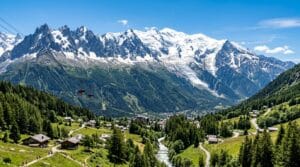
Chamonix-Mont-Blanc sits at a stunning 1,035 meters altitude in the French Alps, just 80 km from Geneva and right below Mont Blanc at 4,805 meters — Western Europe’s highest peak. Honestly, the mountain’s sheer scale is tough to grasp from the valley floor. You’ll see glaciers practically reaching the valley, granite towers like the Aiguilles soaring 3,000 meters from the village streets, and if you take the Aiguille du Midi cable car (France’s highest, at 3,842m), you’ll get a view encompassing 350 km of the Alps on a clear day. It’s absolutely breathtaking.
The valley itself stretches 17 km and includes several distinct villages. There’s central Chamonix Town, which is the main hub; quiet Argentière, about 15 minutes up-valley; and family-friendly Les Houches. Each has its own vibe, but they all share that same incredible backdrop. According to regional tourism data, Chamonix welcomes over 3 million visitors annually, with the split roughly 60/40 between winter and summer.
What’s even more striking? The Chamonix Valley contains approximately 100 km² of glaciated terrain, including the famous Mer de Glace — France’s largest glacier. Scientists have noted an accelerating retreat of these glaciers, so visiting in 2026 feels like a meaningful moment to witness these ancient ice bodies while they’re still so accessible.
Winter in Chamonix (December – March): Alpine Skiing at Its Most Dramatic
Chamonix’s winter identity is skiing, but it’s a very specific kind. This isn’t your typical beginner resort with gentle groomed runs and fancy apres-ski boutiques. No, Chamonix is where the serious skiers come to play: think steep couloirs, challenging off-piste terrain, and the legendary Vallée Blanche — a 23-kilometer off-piste descent from the Aiguille du Midi that remains one of the world’s most extraordinary ski experiences. Trust me, it’s epic.
Here’s what winter offers:
- 115 km of marked pistes spread across multiple ski areas: Les Grands Montets (definitely challenging), Brévent-Flégère (super scenic), Les Houches (great for families).
- Mont Blanc Unlimited day pass: Around €74,, this pass covers all lifts in the valley, plus connections to Courmayeur (Italy) and Verbier (Switzerland). Pretty sweet, right?
- Vallée Blanche: A full-day guided off-piste glacier descent. You absolutely need a guide (€300–450 for a small group), but it’s an unforgettable experience.
- Peak skiing: January–February usually offers the best powder. Just try to avoid French school holidays in February; it gets incredibly crowded, so book 6 months ahead if that’s when you’re going.
- Snow reliability: High — the valley base sits at 1,035m with lots of north-facing terrain. You’ll find reliable snow from mid-December through March.
Winter temperature: At valley level, expect -5°C to 5°C. Above 2,000m, it’s more like -15°C to -5°C. Wind chill on exposed ridges can make it feel even colder, so you’ll want to dress in proper alpine layers.
Best for: Intermediate-to-expert skiers, off-piste enthusiasts, ski mountaineers, and anyone who craves the most dramatic alpine scenery France has to offer.
Book early: Accommodation fills up months in advance for peak winter. I’d suggest searching Booking.com for Chamonix hotels. The sweet spot? Often the gap between February half-term and March spring skiing: good snow and lower prices.
Spring in Chamonix (April – May): The Transitional Season
Spring is Chamonix’s most misunderstood season. In April, it’s still full-on winter at altitude — the Grands Montets and Brévent actually offer excellent “spring skiing” with softer morning snow and much longer daylight hours. Skiers who are in the know absolutely love April: fewer crowds, lower accommodation prices, and you get to ski under a proper sun instead of that typical winter grey.
May, though, is the real transition. Many lifts close for maintenance. Lower hiking trails start opening up, but high passes still hold deep snow. The valley truly explodes with wildflowers; the narcissus fields around Chamonix in late May are spectacular. It’s the quietest month, making it ideal for travelers who want to experience the town without all the crowds.
Worth mentioning: The Aiguille du Midi cable car is scheduled for maintenance closure from November 2 to December 18, 2026. For spring, it usually operates normally — and those summit views in clear May conditions with fresh snow? They’re among the season’s absolute highlights.
Best for: Spring skiers who hate crowds, budget travelers, wildflower enthusiasts, and photographers.
Summer in Chamonix (June – August): Hiking at the Roof of Europe
Summer completely transforms Chamonix from a ski resort into what many consider Europe’s finest hiking destination. The valley floor can hit 20–25°C in July, trails above 2,000m are largely snow-free by early July, and the hiking infrastructure here rivals anything you’ll find in the Alps. It’s a hiker’s paradise, truly.
Summer hiking statistics:
- 350 km of marked hiking trails across all difficulty levels.
- Tour du Mont Blanc (TMB): This 170-km circuit around the Mont Blanc massif takes you through France, Italy, and Switzerland. It usually takes 10–12 days to complete and is easily one of the world’s greatest long-distance trails.
- Daily summer visitors: Over 100,000 at peak times (especially during UTMB week in late August).
- Multiple cable cars run in summer, which is great for non-hikers: Aiguille du Midi, Brévent, Flégère, Plan de l’Aiguille.
Must-do summer experiences:
Aiguille du Midi (3,842m): Take the two-stage cable car to France’s highest observation terrace. You absolutely have to try the “Step into the Void” glass skywalk; it protrudes from the summit, leaving you suspended above a 1,000-meter drop. It’s exhilarating! Book tickets 48 hours in advance online to guarantee access and skip the queues.
Mer de Glace & Montenvers Railway: A historic rack railway (20 minutes from Chamonix) whisks you up to France’s largest glacier at 1,913m. The journey itself, the views from the terrace, and the ice cave (Grotte de Glace) — carved fresh each year into the glacier — are all extraordinary. Plus, the new Glaciarium museum (opened 2024/25) adds some fascinating climate context.
Lac Blanc: A roughly 2-hour hike from the Flégère cable car leads you to a stunning mountain lake that perfectly reflects the entire Mont Blanc massif. It’s one of the most photographed views in Europe, and for good reason. Try to arrive before 10 AM if you want some solitude.
UTMB (Ultra-Trail du Mont Blanc): This is the world’s most prestigious trail race, held in late August. It draws 2,500 runners from 100 countries, plus 15,000 spectators. If you’re in Chamonix that week, the energy is absolutely extraordinary. If you’re hoping for quiet trails, though, you might want to avoid it entirely.
Best for: Hikers of all levels, families (those cable cars make it easy even without peak fitness), trail runners, mountaineers, and anyone who wants to soak in France’s most dramatic mountain scenery.
Autumn in Chamonix (September – October): The Insider’s Season
September is the secret. Seriously. The summer crowds thin out after UTMB, trails are still fully open, the larches turn glorious gold and orange in October (a color show that rivals anywhere in Europe), and accommodation prices drop by a good 30–40%. Temperatures are cool, around 10–18°C in the valley, but still perfectly comfortable for hiking.
October is the quietest month — and because of that, it’s also the most atmospheric. The village feels like it returns to its true French roots, local restaurants aren’t overwhelmed, and the light on those granite needles in October mornings is just extraordinary for photography. By late October, you’ll see the first snows arriving at altitude, and the anticipation for ski season really starts to build.
Here’s what stays open in autumn: The Aiguille du Midi (until November 2), the Montenvers Railway, and most valley hiking trails. Just know that most high-altitude trails close by mid-October due to snow.
Best for: Budget travelers, photographers, couples, and repeat visitors who know the summer crowds and want to experience the mountain without them.
Getting to Chamonix: Practical Logistics
Getting to Chamonix is quite straightforward, with Geneva Airport (GVA) being the most common access point, located 80 km away. Here are your options:
- Shared shuttle (Alpine Fleet, Mountain Drop-offs): Expect to pay €20–35 per person, and the ride takes about 75–90 minutes. This is usually the best value for solo travelers.
- Bus (FlixBus, BlaBlaBus): A cheaper option at €5–15, though it takes a bit longer, around 2 hours.
- Private transfer: This will set you back €120–180 for a car, but it’s instant and direct, which can be worth it for groups or those with lots of gear.
From Paris: Take the TGV to Annecy or Bellegarde (about 2.5 hours), then transfer to a regional train or bus to Chamonix (another 2–3 hours). Total travel time is usually ~5.5–6 hours. You’ll want to book TGV tickets 90 days in advance on SNCF for the best fares.
Within the valley: The Chamonix Mobilité card, which your hotel or gîte provides for free, covers unlimited free travel on all valley buses and the Mont-Blanc Express narrow-gauge railway between Les Houches and Argentière. Honestly, with this card, you really don’t need a car for your entire stay. For more information, check out find the best European trips.
Where to Stay in Chamonix: By Season and Budget
| Budget Level | Type | Cost/Night | Best For |
|---|---|---|---|
| Budget | Hostel dorm | €45–60 | Solo travelers, summer hiking |
| Mid-range | 3-star hotel/apartment | €150–250 | Couples, families, most visitors |
| Premium | 4–5 star chalet | €400–1,000+ | Ski groups, honeymoons, splurges |
For the best selection and to easily compare prices, definitely check out Chamonix properties on Booking.com. My tip? Filter by “Mont-Blanc views” — paying a small premium for a mountain-facing room truly transforms the experience, especially at sunrise.
Insider tip: Argentière village, just 15 minutes from Chamonix center by free bus, offers a quieter, more authentically French alpine atmosphere. Plus, you’ll typically find accommodation prices 20–30% lower than in central Chamonix. Worth considering, don’t you think?
Chamonix Food and the Local Table
Chamonix eats exactly like you’d expect in the French Alps: hearty, deliciously cheese-forward, and unapologetically rich. Savoyarde cuisine dominates the scene: think fondue savoyarde (a blend of three melted cheeses), raclette (melted cheese scraped over potatoes), tartiflette (a gratin of potatoes, Reblochon cheese, and bacon), and Diots (local pork sausages in white wine). After a long day on the mountain, these dishes are precisely what you need to refuel.
The central pedestrian street (Rue du Docteur Paccard) has the highest concentration of restaurants. But for something a bit off the tourist circuit, I’d suggest heading to the side streets around the church. The best fondue I’ve ever had in the Alps was at a tiny counter-service spot with no website, which I only found by following a local family at 7 PM on a Tuesday. Sometimes, you just have to explore!
For more regional food context across France, our best French food guide dives deep into Savoyarde cuisine alongside every other French region. And if Chamonix is part of a wider French Alps circuit for you, our Lyon travel guide (2.5 hours from Chamonix) and the Alsace wine route guide are natural complements for an extended French trip.
Frequently Asked Questions
When is the best time to visit Chamonix in 2026?
For skiing, you’ll want to aim for January–February; that’s when you’ll find the best snow and conditions. If hiking is your main goal, late June through September is ideal, as trails are fully open and the weather’s generally good. For budget travelers and those seeking quiet, October is fantastic with the lowest prices, gorgeous golden autumn colors, and hiking still very much possible. Spring skiing in April offers good snow with the smallest crowds.
How do I get from Geneva to Chamonix?
The fastest and most convenient option is a shared shuttle, costing around €20–35 and taking 75–90 minutes. For a more budget-friendly choice, FlixBus is €5–15 and takes about 2 hours. Both services depart from Geneva Airport and drop you right in central Chamonix. Private transfers, at €120–180 per car, are definitely worth it for families or groups with heavy ski equipment.
Is Chamonix good for non-skiers in winter?
Yes, absolutely! The Aiguille du Midi cable car runs year-round (except for maintenance closures), giving non-skiers access to extraordinary 3,842m summit views. You can also enjoy snowshoeing, ice skating, lovely winter walks along the valley, and the excellent spa-wellness scene (many hotels have pools and saunas). So, you’ll have plenty to do even without ski boots.
What is the Tour du Mont Blanc?
The Tour du Mont Blanc is a 170-km long-distance hiking trail that actually circuits the entire Mont Blanc massif, taking you through France, Italy, and Switzerland. Most walkers complete it in 10–12 days. It’s consistently ranked among the world’s 10 best long-distance trails. The best season to hike it is late June through September, when the high passes are typically snow-free.
Is Chamonix expensive?
Since it’s a major international resort town, yes, costs in Chamonix are generally higher than average French destinations. Budget travelers can usually manage on €100–130 per day (think hostel, groceries, and free hiking). Mid-range spending, which includes a hotel, some restaurant meals, and one lift pass, will run you about €200–250 per day. If you go during shoulder seasons (April, October), you can often reduce accommodation costs by 30–40%.
Can I visit Chamonix without a car?
You can visit Chamonix easily without a car. The free Chamonix Mobilité card, which your accommodation provides, covers all buses and the Mont-Blanc Express train within the valley. Plus, convenient shuttle services connect Geneva Airport directly to Chamonix. Honestly, a car is genuinely unnecessary for a standard visit here.