Table of Contents
- Why Provence’s Hidden Villages Are Worth the Detour
- 1. Gordes — The Stone Fortress Above the Lavender
- 2. Roussillon — The Ochre Village That Glows at Sunset
- 3. Lacoste — The Marquis de Sade’s Hilltop Refuge
- 4. Bonnieux — Cedar Forests and Roman Bridges
- 5. Lourmarin — The Literary Village of the Luberon
- 6. Moustiers-Sainte-Marie — The Star Between Two Cliffs
- 7. Seguret — Wine, Warmth, and Medieval Walls
- 8. Venasque — One of France’s Oldest Villages
- 9. Ansouis — The Castle Village Time Forgot
- 10. Simiane-la-Rotonde — Lavender Capital of Haute-Provence
- 11. Saignon — The Rock Village Above Apt
- 12. Oppede-le-Vieux — The Abandoned Medieval Ghost Village
- 13. Aurel — Lavender Fields Without the Crowds
- 14. Brantes — The Tiny Hamlet Facing Mont Ventoux
- 15. Bargeme — The Highest Village in the Var
- How to Plan Your Provence Village-Hopping Trip
- Frequently Asked Questions
Why Provence’s Hidden Villages Are Worth the Detour
Provence attracts over 30 million visitors every year, yet most of them never leave the well-trodden path between Aix-en-Provence and Avignon. They photograph the same lavender fields, eat at the same restaurants in Saint-Remy, and return home without ever discovering the villages that make Provence genuinely extraordinary.
The hidden villages of Provence — perched on limestone cliffs, tucked into gorges, or scattered across rolling lavender plateaus — offer something no guidebook itinerary can replicate: silence, authenticity, and a connection to a way of life that has barely changed in centuries. These are places where the baker still opens at 6 AM, where the only traffic jam involves a flock of sheep, and where a glass of local rose on a stone terrace costs less than a bottle of water in Paris.
After spending years exploring every corner of this region, we have assembled this list of 15 hidden Provencal villages that deserve a place on your 2026 itinerary. Each one has been selected for its unique character, accessibility, and the kind of quiet beauty that stays with you long after you leave.
1. Gordes — The Stone Fortress Above the Lavender
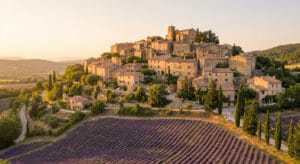
Gordes is technically not a secret — it has been classified as one of the “Plus Beaux Villages de France” for decades — but most visitors see it only from the famous viewpoint across the valley. They snap a photo and drive on. That is a mistake.
Walking the steep, narrow streets of Gordes reveals layers of history that no viewpoint can capture. The village is built entirely from local limestone, and the warm grey stone seems to absorb and reflect the Provencal light in a way that changes by the hour. At the top sits a Renaissance chateau, now home to a contemporary art museum featuring works by the Flemish-Belgian painter Pol Mara.
What makes it special: The Village des Bories, a collection of dry-stone huts dating back to the Bronze Age, sits just 2 kilometers outside the village. These structures, built without mortar, have survived for over 3,000 years and offer a haunting glimpse into prehistoric Provencal life.
Best time to visit: Late June to mid-July, when the lavender fields surrounding the nearby Senanque Abbey are in full bloom. Arrive before 8 AM to avoid the tour buses.
Getting there: 38 km east of Avignon. No direct public transport — a rental car is essential for exploring the Luberon villages.
2. Roussillon — The Ochre Village That Glows at Sunset
Roussillon looks like it was painted by an artist who ran out of every color except red, orange, and gold. Built directly on ochre deposits that were mined commercially until the 1930s, the village’s buildings range from deep crimson to pale amber, creating a visual effect that is genuinely unlike anywhere else in France.
The Sentier des Ocres (Ochre Trail) winds through former quarries where the exposed rock faces reveal 17 distinct shades of ochre. The geological story is remarkable: these deposits formed over 100 million years ago when the region was covered by a tropical sea, and the iron oxide in the sandstone created the dramatic color palette visible today.
What makes it special: The Conservatoire des Ocres, housed in a former ochre factory, offers workshops where you can learn to make your own natural pigments — the same pigments used by prehistoric cave painters and Renaissance masters.
Best time to visit: Golden hour (the hour before sunset) transforms the village into something almost surreal. The ochre walls intensify to a deep, burning orange that photographs beautifully.
Insider tip: The Thursday morning market is small but excellent, with local producers selling goat cheese, honey, and lavender products directly. Arrive by 9 AM for the best selection.
3. Lacoste — The Marquis de Sade’s Hilltop Refuge
Lacoste’s dramatic hilltop position and notorious history give it an edge that sets it apart from the more conventionally pretty Luberon villages. The ruined chateau at the summit was once the residence of the Marquis de Sade, who retreated here to escape Parisian scandal in the 18th century. Today, the chateau is owned by the fashion designer Pierre Cardin, who restored parts of it and hosts an annual summer arts festival.
Below the chateau, the village descends through narrow stone passages and arched doorways. The population is tiny — fewer than 450 permanent residents — but the presence of the Savannah College of Art and Design (SCAD), which operates a study-abroad campus here, gives Lacoste an unexpected creative energy.
What makes it special: The Festival de Lacoste, held each July in the quarries beneath the chateau, features opera, theater, and dance performances in a setting that is both intimate and spectacular. Tickets sell out months in advance.
Best time to visit: Late afternoon, when the sun hits the western face of the village and the stone glows gold against the deep blue Provencal sky.
4. Bonnieux — Cedar Forests and Roman Bridges
Bonnieux sits across the valley from Lacoste, and the two villages stare at each other across a landscape of vineyards and cherry orchards. The rivalry between them is centuries old and entirely friendly — residents of each village will tell you, with complete conviction, that theirs is the more beautiful of the two.
The old village climbs steeply to a 12th-century church at the summit, from which the views extend to the Vaucluse plateau, Mont Ventoux, and the distant Alps on clear days. But the real treasure lies 6 kilometers south: the Foret des Cedres, a magnificent cedar forest planted in 1862 with seeds brought from the Atlas Mountains of North Africa. Walking through it feels like being transported to another continent entirely.
What makes it special: The Pont Julien, a perfectly preserved Roman bridge dating from 3 BC, stands just outside the village. It carried traffic on the Via Domitia — the road connecting Rome to Spain — for over 2,000 years, until a modern bridge replaced it in 2005.
Best time to visit: Spring (April-May), when the cherry orchards are in bloom and the hillsides are covered in wildflowers. The Friday morning market is one of the best in the Luberon.
5. Lourmarin — The Literary Village of the Luberon
Lourmarin has long attracted writers, artists, and intellectuals. Albert Camus bought a house here in 1958 with the proceeds from his Nobel Prize, and he is buried in the village cemetery alongside his wife Francine. Henri Bosco, the Provencal novelist, also lived and wrote here.
Unlike many hilltop Provencal villages, Lourmarin sits in the valley, giving it a more relaxed, accessible feel. The Friday morning market fills the main street with stalls selling local produce, antiques, and Provencal fabrics. The Renaissance chateau, one of the first built in Provence, hosts a year-round program of concerts and literary events.
What makes it special: The village maintains a genuine literary culture. The bookshop on the main square stocks an impressive selection of French and English literature, and the Fondation Robert Laurent-Vibert at the chateau offers residencies to writers and artists from around the world.
Getting there: Lourmarin marks the southern entrance to the Combe de Lourmarin, a narrow gorge that cuts through the Luberon massif — the drive through it is spectacular.
6. Moustiers-Sainte-Marie — The Star Between Two Cliffs
A gold star on a 227-meter chain stretches between two cliffs above Moustiers-Sainte-Marie. Legend says a crusading knight, the Chevalier de Blacas, hung it there in gratitude after returning safely from the Seventh Crusade. Whether the legend is true or not, the star is real, and it gives Moustiers an unmistakable identity.
The village itself is built at the mouth of a gorge where a waterfall cascades through the center of town. Moustiers has been famous for its faience (decorated pottery) since the 17th century, and a dozen workshops still produce it using traditional techniques. The Musee de la Faience documents 400 years of the craft with a collection of over 500 pieces.
What makes it special: The Gorges du Verdon — Europe’s deepest canyon at 700 meters — begins just 20 minutes away. The turquoise Lac de Sainte-Croix at the canyon’s entrance offers kayaking, swimming, and pedal-boat access into the gorge itself.
Best time to visit: September, when the summer crowds have thinned but the weather remains warm and the lake is still swimmable. The lavender has faded, but the vineyards are beginning their autumn transformation.
7. Seguret — Wine, Warmth, and Medieval Walls
Seguret is a tiny village of just 900 inhabitants clinging to the western slope of the Dentelles de Montmirail, a dramatic range of limestone peaks that look like a row of jagged teeth against the sky. The village is surrounded by some of the best vineyards in the southern Rhone Valley, and several excellent domaines offer tastings within walking distance.
The medieval center is remarkably intact: a 12th-century belfry, a covered passageway called the “Rue des Poternes,” and a ruined castle at the top that offers panoramic views across the Rhone plain to the Cevennes mountains. At Christmas, the entire village is transformed into a living nativity scene (creche vivante), with residents in period costume performing throughout the streets.
What makes it special: The wines. Seguret produces its own village-level Cotes du Rhone, and the terroir gives the reds a distinctive mineral quality. The Domaine de Cabasse and Domaine de l’Amauve are particularly worth visiting.
Insider tip: The hike from Seguret to the Col du Cayron through the Dentelles de Montmirail (about 3 hours round-trip) is one of the finest short walks in all of Provence, with views that rival any Alpine trail.
8. Venasque — One of France’s Oldest Villages
Venasque claims to be the settlement that gave its name to the entire Comtat Venaissin, the region around Carpentras that was ruled by the popes for nearly 500 years. Whether or not the etymology is accurate, the village’s antiquity is beyond dispute: the Baptistere, a Merovingian baptistery dating from the 6th century, is one of the oldest religious structures in France.
The village occupies a defensive position on a rocky spur overlooking the Nesque gorge, and its ramparts and towers are substantial enough to suggest that Venasque was once a place of genuine strategic importance. Today, it is quiet, unhurried, and almost entirely free of tourists — even in August.
What makes it special: The Gorges de la Nesque, accessible by a spectacular cliff road from Venasque to Sault, is often called the “mini Verdon.” The road passes through tunnels carved into the rock and offers vertigo-inducing views into the 400-meter-deep canyon below.
Best time to visit: Late June, when the cherry harvest is underway. Venasque cherries are considered among the finest in France, and the annual cherry festival is a local highlight.
9. Ansouis — The Castle Village Time Forgot
Ansouis is dominated by a chateau that has been inhabited by the same family — the Sabran-Ponteves — for over 800 years. This continuity of ownership is extraordinary, and it means the chateau’s interior reflects centuries of accumulated taste, from medieval tapestries to Flemish paintings to 18th-century Provencal furniture.
The village below the chateau is tiny and perfectly preserved, with stone houses lining narrow streets that end in unexpected terraces offering views across the Durance valley to the Luberon mountains. The Musee Extraordinaire, housed in a vaulted cellar, displays an eccentric collection of underwater paintings and diving equipment assembled by a local artist.
What makes it special: The sheer density of history in such a small space. Within a radius of 200 meters, you can see Romanesque, Gothic, and Renaissance architecture, all in excellent condition and all still serving their original purposes.
10. Simiane-la-Rotonde — Lavender Capital of Haute-Provence
Simiane-la-Rotonde takes its name from the remarkable Romanesque rotunda that crowns the village — a 12th-century structure with outstanding acoustics that now serves as a concert hall during the annual Festival des Musiques Anciennes. The architecture is unique in Provence: a dodecagonal (12-sided) domed room that some scholars believe was inspired by the Church of the Holy Sepulchre in Jerusalem.
The village sits at 650 meters altitude on the edge of the Plateau d’Albion, one of the most productive lavender-growing areas in France. In July, the fields surrounding the village are a sea of purple that extends to the horizon in every direction. The distilleries here produce some of the highest-quality lavender essential oil in the world, with an ester content that exceeds 40%.
What makes it special: The combination of medieval architecture, world-class lavender, and an active cultural program makes Simiane feel like a village that is simultaneously ancient and alive. The Sunday morning market features lavender products, local honey, and goat cheese from farms you can see from the village walls.
11. Saignon — The Rock Village Above Apt
Saignon is built around and into a massive outcrop of rock that rises above the town of Apt in the central Luberon. The “Rocher de Saignon” (Saignon Rock) dominates the village, and houses have been carved directly into its base for centuries. The effect is dramatic — a seamless transition from natural rock to human construction that blurs the boundary between geology and architecture.
The village has attracted a community of artists and craftspeople who have opened studios and galleries in the old stone buildings. The atmosphere is creative but unpretentious, with none of the gallery-district polish that can make other art villages feel artificial.
What makes it special: The three Romanesque churches (an unusual number for such a small village) suggest that Saignon was once far more important than its current size indicates. The oldest, Notre-Dame de Pitie, contains 11th-century frescoes that are among the finest in Provence.
Getting there: Just 4 km from Apt, making it an easy side trip if you are visiting the famous Saturday morning market — the largest and most authentic in the Luberon.
12. Oppede-le-Vieux — The Abandoned Medieval Ghost Village
Oppede-le-Vieux is unlike any other village on this list because it is largely abandoned. In the 19th century, the inhabitants gradually moved downhill to the more practical location of Oppede-les-Poulivets, leaving the medieval village to crumble slowly back into the rock from which it was built.
Today, the old village is a haunting ruin reached by a steep 20-minute climb through forest and overgrown terraces. Ivy-covered walls, doorways opening onto nothing, and the skeleton of the 13th-century Collegiate Church create an atmosphere that is equal parts beautiful and melancholic. The chateau at the top, built by the Counts of Toulouse, offers views across the entire north Luberon.
What makes it special: During World War II, the artist Consuelo de Saint-Exupery (wife of the author of The Little Prince) established a small colony of artists and refugees in the ruins. Her memoir, “The Tale of the Rose,” describes the community they built among the crumbling walls.
Practical note: Wear sturdy shoes. The path is rocky and uneven, and parts of the ruins are unstable. There are no facilities in the old village — bring water.
13. Aurel — Lavender Fields Without the Crowds
While tourists flock to Valensole and Senanque for their lavender photos, Aurel remains virtually unknown. This tiny village of 200 inhabitants sits on a hillside above some of the most photogenic lavender fields in Provence, with the added advantage of having the rugged Montagne de Lure as a backdrop.
The lavender here is “fine lavender” (Lavandula angustifolia) rather than the more common lavandin hybrid, which means the fields are at higher altitude and the essential oil is of superior quality. Several small producers sell directly from their farms, offering prices that are a fraction of what you would pay in the tourist shops of Aix or Avignon. For more information, check out plan your Europe trip.
What makes it special: The complete absence of tourist infrastructure. There is one cafe, one small shop, and no tour buses. If you want to photograph lavender fields in total solitude, Aurel is where you go.
Best time to visit: The first two weeks of July, when the fine lavender is at peak bloom. By late July, the harvest begins.
14. Brantes — The Tiny Hamlet Facing Mont Ventoux
Brantes has a population of roughly 80 people, and visiting it feels less like arriving at a village than finding a secret. It clings to the north face of a steep valley with a direct, unobstructed view of Mont Ventoux — the “Beast of Provence” that looms over the entire region like a white-capped sentinel.
The village has a single narrow street, a 12th-century chapel, and a restored Renaissance chateau that now operates as a cultural center hosting pottery workshops and concerts. In winter, when the tourists have gone entirely, Brantes is one of the quietest inhabited places in all of southern France.
What makes it special: The Toulourenc river, which flows through the valley below Brantes, offers some of the best wild swimming in Provence. The water is cold and crystal clear, running through narrow gorges where you can walk upstream in the riverbed with water between ankle and waist depth — a uniquely Provencal experience.
15. Bargeme — The Highest Village in the Var
At 1,097 meters altitude, Bargeme is the highest village in the Var department, and it feels genuinely remote despite being only 90 minutes from the Cote d’Azur. The ruined 13th-century castle of the Ponteves family dominates the skyline, and the fortified Romanesque church of Saint-Nicolas contains remarkable medieval frescoes that were only rediscovered in the 1980s.
The village is surrounded by the Parc Naturel Regional du Verdon, and the walking trails that radiate from it lead through forests of Scots pine and Alpine meadows that feel more like the Pyrenees than Provence. The air is noticeably cooler and crisper than in the lowland villages, making Bargeme an ideal refuge during the fierce August heat.
What makes it special: The sense of altitude and isolation. At over 1,000 meters, Bargeme has stargazing conditions that are exceptional for southern France. On clear nights, the Milky Way is clearly visible overhead — a rarity in increasingly light-polluted Europe.
Getting there: The D21 road from Comps-sur-Artuby winds through spectacular scenery but is narrow and winding. Not recommended for large campervans.
How to Plan Your Provence Village-Hopping Trip
Best Time to Visit
The ideal window is mid-June to mid-July, when the lavender is in bloom, the weather is warm but not yet scorching, and the peak summer crowds have not fully arrived. September is an excellent alternative: the temperatures are comfortable, the vineyards are beautiful, and accommodation prices drop significantly.
Avoid August if possible. Temperatures regularly exceed 35 degrees Celsius, many small businesses close for their own holidays, and the popular villages can feel overcrowded.
Getting Around
A rental car is non-negotiable for exploring hidden villages. Public transport in rural Provence is minimal, and many of these villages have no bus service at all. Consider renting from Avignon TGV station, which has direct high-speed rail connections from Paris (2 hours 40 minutes), Lyon (1 hour), and Marseille (30 minutes).
Budget around 30-50 euros per day for a compact car rental, plus fuel. The distances between villages are short — rarely more than 30-40 km — but the winding mountain roads mean journey times are longer than you might expect.
Where to Stay
Skip the chain hotels along the autoroute. The best Provence experiences come from staying in the villages themselves:
- Chambres d’hotes (B&Bs): Typically 80-150 euros per night, with breakfast included and local knowledge that no guidebook can match.
- Gites ruraux (rural cottages): Ideal for longer stays, usually rented by the week. Expect 500-1,200 euros per week depending on size and season.
- Camping: Municipal campsites near many of these villages offer pitches for 15-25 euros per night. The quality varies widely, but the settings are often spectacular.
Budget Considerations
Provence can be expensive, but the hidden villages are significantly cheaper than the tourist hubs. A realistic daily budget:
- Budget traveler: 80-120 euros/day (camping or basic chambre d’hotes, market picnics, free activities)
- Mid-range: 150-250 euros/day (comfortable B&B, restaurant lunch, wine tasting)
- Luxury: 300+ euros/day (boutique hotel, gastronomic dining, private tours)
Suggested 7-Day Itinerary
Days 1-2: Luberon loop — Gordes, Roussillon, Lacoste, Bonnieux, Lourmarin. Base yourself in Bonnieux or Lourmarin.
Days 3-4: Ventoux and northern Provence — Seguret, Venasque, Brantes. Base in Seguret for the wine access.
Day 5: Haute-Provence — Simiane-la-Rotonde, Aurel. Base in Simiane or nearby Banon (famous for its cheese).
Days 6-7: Verdon area — Moustiers-Sainte-Marie, Bargeme, with a day at the Gorges du Verdon. Base in Moustiers.
Frequently Asked Questions
What is the best month to see lavender in Provence?
Lavender season in Provence runs from mid-June to early August, but the peak bloom period is typically the last two weeks of June through the first two weeks of July. Fine lavender at higher altitudes (like around Aurel and Simiane-la-Rotonde) blooms slightly later than the lavandin hybrids found at lower elevations. The harvest usually begins in mid to late July, so timing your visit before then is essential if you want to see full fields in bloom.
Can you visit Provence villages without a car?
It is technically possible but very difficult. Public bus services connect some larger towns like Apt, Cavaillon, and Carpentras, but most of the villages on this list have no public transport access at all. Your best options without a car are: renting an e-bike (increasingly available from Avignon and Apt), joining a guided minibus tour (several operators run day trips from Avignon and Aix), or using a combination of regional buses and taxis. However, you will miss the spontaneity that makes village-hopping special, so we strongly recommend renting a car.
Are Provence villages accessible for people with mobility challenges?
Most hilltop villages have steep, cobblestoned streets that present significant challenges for wheelchair users or people with limited mobility. Lourmarin, which sits in the valley rather than on a hill, is the most accessible village on this list. Moustiers-Sainte-Marie has a relatively flat lower village section. For the others, the historical architecture means that accessibility modifications are limited. If mobility is a concern, focus on the valley-level villages and enjoy the hilltop ones from the viewpoints below.
How much time should I spend in each village?
Most hidden villages can be explored in 2-3 hours if you are simply walking and photographing. However, we recommend allowing a full half-day (4-5 hours) for villages where you want to visit museums, do wine tastings, or hike nearby trails. For villages like Moustiers-Sainte-Marie or Seguret, where there are significant activities nearby (the Gorges du Verdon and Dentelles de Montmirail, respectively), plan a full day. Trying to visit more than 2-3 villages per day leads to “village fatigue” — they start to blur together, and you miss the details that make each one unique.
Is it safe to drink tap water in Provence villages?
Yes. Tap water in France is safe to drink everywhere unless specifically marked “eau non potable.” Many villages have public fountains — some dating back centuries — where you can refill water bottles for free. The fountain water in mountain villages is often excellent, sourced from natural springs. Carrying a refillable bottle is both practical and environmentally responsible, especially since single-use plastic bottles are increasingly discouraged throughout Provence.
What local foods should I try in Provence villages?
Each village has its specialties, but essential Provencal foods to seek out include: tapenade (olive paste), fougasse (flatbread with olives or anchovies), ratatouille made with local summer vegetables, daube Provencale (slow-cooked beef stew with red wine and herbs), pieds et paquets (a traditional Marseillais tripe dish, not for everyone), calissons (almond-and-melon sweets from Aix), and the ubiquitous rose wine. At village markets, look for brousse du Rove (a fresh goat cheese), Banon cheese (wrapped in chestnut leaves), and local honey — lavender honey from Haute-Provence has its own AOC designation, guaranteeing its origin and quality.
Do people speak English in small Provence villages?
In the more tourist-oriented villages (Gordes, Roussillon, Lourmarin), you will find reasonable English spoken in restaurants and shops. In genuinely remote villages like Brantes, Bargeme, or Aurel, English is rare. Learning a few basic French phrases will significantly improve your experience and is appreciated by locals. Essential phrases include: “Bonjour” (always greet before asking anything), “Parlez-vous anglais?” (do you speak English?), “L’addition, s’il vous plait” (the bill, please), and “C’est magnifique” (it’s magnificent — useful constantly in Provence).