Hidden Paris Neighborhoods Locals Love: Insider Guide 2026
Last Updated: March 2026
Paris has 20 arrondissements, but most tourists spend their entire trip in a 3km radius of the Eiffel Tower. Here are the neighborhoods that Parisians actually live in — the ones where the bakeries are better, the cafés are cheaper, and nobody’s trying to sell you a miniature Tower.
Related France Guides
Table of Contents
- Why Parisian Neighborhoods Beat the Tourist Circuit
- What Travel Guides Get Wrong About “Authentic Paris”
- 8 Hidden Paris Neighborhoods Worth Your Time
- Practical Planning: Metro Lines, Costs, Timing
- Hidden Gems Only Locals Know
- ETIAS & Entry Requirements for 2026
- Frequently Asked Questions
I moved to Paris fifteen years ago and spent the first month doing exactly what tourists do. Then a Parisian neighbor took me to her local market in the 11th, her wine bar in Ménilmontant, and her Sunday brocante in the 20th. I’ve been exploring the real Paris ever since — and I’ve never needed a tourist map.
Why Parisian Neighborhoods Beat the Tourist Circuit
Paris received 47.5 million visitors in 2024 (Paris Convention and Visitors Bureau), but the vast majority concentrate in just six areas: the Eiffel Tower, Louvre, Notre-Dame, Montmartre, Marais, and Champs-Élysées. These are spectacular — and genuinely overcrowded.
The neighborhoods where Parisians actually live operate at a completely different rhythm. Café waiters who remember your order, boulangeries with a queue of locals (reliable quality signal), parks where children actually play rather than tourists photograph. The difference is qualitative, not just aesthetic.
Cost matters too: a coffee on the Champs-Élysées costs €5–6. The same coffee in the 11th or 20th: €2.50–3. Restaurants in non-tourist neighborhoods charge 30–50% less for equivalent quality.
What Travel Guides Get Wrong About “Authentic Paris”
Every travel blog recommends Montmartre as an “authentic” neighborhood. It hasn’t been authentically Parisian since the 1990s. The artists left when the rent went up; what remains is a beautiful hill covered in souvenir shops and portrait artists serving tourists who’ve been told this is where Picasso lived.
The same has happened to most of the Marais. Saint-Germain-des-Prés lost its intellectual café scene twenty years ago — Café de Flore and Les Deux Magots are now charging €8 for a café crème and catering almost entirely to people photographing themselves where Simone de Beauvoir once sat.
Authentic Paris in 2026 is in the 10th, 11th, 18th (northern half), 19th, and 20th arrondissements. These are the neighborhoods where the city is actually alive.
8 Hidden Paris Neighborhoods Worth Your Time
1. Ménilmontant (20th) — The Real Bohemian Paris
Metro: Ménilmontant (line 2) or Gambetta (lines 3, 3b) | Best for: Natural wine bars, street art, local cafés
Ménilmontant is what Montmartre was 30 years ago — artists, musicians, young professionals, and old working-class Parisian families all sharing the same steep streets. The natural wine bar scene here (La Cave des Papilles nearby, Septime La Cave in the 11th) has made it a destination for serious wine drinkers.
I visited the Belleville street art circuit last autumn and discovered a full outdoor gallery along Rue Denoyez — completely free, changes seasonally, known mostly to locals and art students. Coffee at Le Barbouquin (1 Rue des Envierges, €2.50) overlooking the Paris skyline is the best view you’ll pay almost nothing for.
2. Oberkampf / Rue de la Roquette (11th) — Where Young Paris Lives
Metro: Oberkampf (lines 5, 9) or Voltaire (line 9) | Best for: Evening drinks, neighborhood restaurants, Sunday market
The 11th arrondissement is where most working Parisians between 25 and 45 actually live. The restaurant scene around Oberkampf and Parmentier has become one of the city’s most interesting — Septime (80 Rue de Charonne) is regularly ranked among Europe’s best restaurants and still manages a €52 lunch menu.
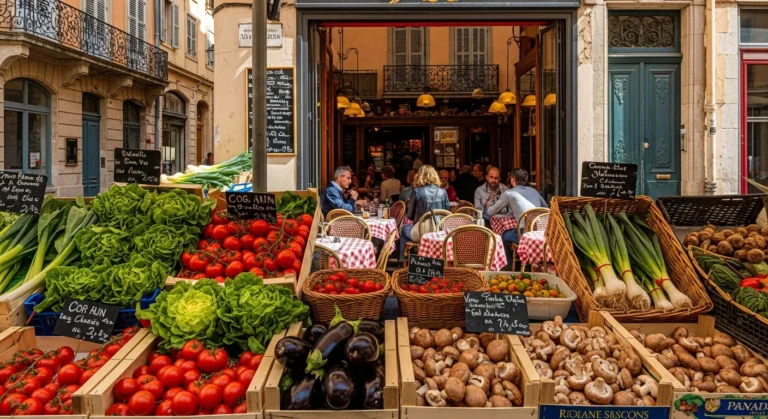
The Marché de la Bastille (Thursday and Sunday mornings, Boulevard Richard-Lenoir) is the best outdoor food market in Paris — 150+ vendors, flowers, cheese, olive oil, rotisserie chickens with the dripping juice running into the pan of roasting potatoes beneath. Arrive by 9am.
3. Canal Saint-Martin (10th) — The Comeback Neighborhood
Metro: Jacques Bonsergent (line 5) or République (lines 3, 5, 8, 9, 11) | Best for: Cafés, boutiques, picnic on the canal banks
The Canal Saint-Martin was industrial, then neglected, then discovered by bobo Parisians, then briefly over-hyped, and has now settled into being genuinely excellent. The iron footbridges, tree-lined quays, and lock system are beautiful, especially in spring.
Picnic culture on the canal banks is real — locals bring wine, cheese, and baguettes on summer evenings. Buy everything at the Marché Saint-Quentin (covered market, 85 bis Boulevard Magenta, open Tue–Sat). The canal area’s independent boutique scene (clothing, design, books) is the best in Paris for non-chain shopping.
4. La Butte-aux-Cailles (13th) — Village Within the City
Metro: Place d’Italie (lines 5, 6, 7) | Best for: Village atmosphere, outdoor seating, affordable bars
La Butte-aux-Cailles feels like a village that Paris accidentally grew around. Low buildings, narrow streets, murals everywhere, and a central square (Place de la Butte-aux-Cailles) with outdoor terraces that fill up every evening regardless of weather. The street art quality here rivals Berlin.
Le Temps des Cerises (18 Rue de la Butte-aux-Cailles) is a workers’ cooperative restaurant running since 1976 — lunch formule for €14, genuine neighborhood atmosphere. The open-air municipal swimming pool nearby (Piscine de la Butte-aux-Cailles, €3.80 entry) is a 1920s Art Deco masterpiece that locals actually use to swim.
5. Batignolles (17th) — The Organic North
Metro: Brochant (line 13) or Rome (line 2) | Best for: Organic market, families, green spaces
Batignolles has been Paris’s organic-leaning, family neighborhood for two decades. The Saturday marché biologique on Boulevard des Batignolles (8am–2pm) is the finest organic market in Paris — everything certified, local producers, €3 glasses of natural wine poured from the bottle. Quieter and more authentic than the more famous Marché Raspail on the Left Bank.
6. Charonne / Père Lachaise (20th/11th border) — Unexpected Calm
Metro: Alexandre Dumas (line 2) or Charonne (line 9) | Best for: Cemetery visit, village streets, authentic bistros
Père Lachaise Cemetery (44 hectares, free entry) is the most visited cemetery in the world — but most visitors only go to Jim Morrison’s grave. The rest of the cemetery is a forest city with extraordinary 19th-century monuments, peaceful paths, and complete absence of crowds in the northern sections.
The streets around Charonne (Rue de Charonne, Rue Léon Frot) are lined with excellent small restaurants where a three-course menu runs €16–22 at lunch. This is the Paris where the chef knows the regulars’ names.
7. Montorgueil (2nd) — Market Street That Survived Tourism
Metro: Les Halles (lines 4, A, B, D) or Sentier (line 3) | Best for: Morning market shopping, café culture, classic brasserie
Rue Montorgueil is a pedestrian market street that has managed to remain genuinely useful to Parisians despite being discovered by tourists. The fishmongers, fromagers, and bakers serve real customers alongside visitors. Stohrer (51 Rue Montorgueil) is the oldest patisserie in Paris (founded 1730) — the rum baba was invented here. €4 for a slice.
8. Goutte d’Or (18th) — Paris’s Most Diverse Neighborhood
Metro: Barbès-Rochechouart (lines 2, 4) | Best for: West African and North African food, fabric market, spice shops
Goutte d’Or is Paris’s most culturally diverse neighborhood — West African, North African, Caribbean, Asian communities overlapping in a 5-block radius. The fabric market (Tuesday–Sunday mornings, Rue Dejean) is astonishing for colors and price. The street food circuit — Senegalese thiéboudienne, Malian griot, Moroccan msemen — is extraordinary at €4–8 a plate.
Practical Planning: Metro Lines, Costs, Timing
Getting around: Paris’s metro covers all these neighborhoods efficiently. A carnet of 10 tickets: €17.35 (purchased at metro stations). The day pass (Navigo Liberté+): €8.65 covers unlimited metro, bus, and RER within Paris. Vélib’ bike sharing: €3/day for a 1-day pass.
Markets run Tuesday, Friday, Saturday, Sunday mornings (7:30am–1:30pm for most). Sunday is the best market day in Paris — more vendors, fuller atmosphere, Parisians doing their weekly shop.
Budget: Coffee €2.50–3 | Boulangerie breakfast €4–7 | Market lunch €10–18 | Neighborhood bistro dinner €22–35 | Natural wine bar drinks €5–9 per glass. Total comfortable daily spend: €60–90 eating and drinking well.
Hidden Gems Only Locals Know
Piscine Joséphine Baker (floating pool on the Seine, 13th, near Bibliothèque nationale): An outdoor pool on a barge in the Seine. Entry €3.80. Open late May through September. Parisians swim here while tourists queue at Notre-Dame 3km away.
Le Plateau (Parc des Buttes-Chaumont, 19th): The most beautiful park in Paris — not the Tuileries or Luxembourg (tourist areas) but this 25-hectare landscaped park with a cliff, lake, suspension bridge, and temple folly. Sunday mornings feel like the whole neighborhood gathers here. Bring a baguette.
Passage Brady (10th): An 1828 covered passage that became Paris’s “Little India” — curry houses, sari shops, spice merchants all in a 19th-century glass-roofed arcade. Lunch for €10–12, extraordinary atmosphere. Metro: Château d’Eau (line 4).
ETIAS & Entry Requirements for 2026
Non-EU visitors need ETIAS authorization to enter France from 2026. Cost: €7, valid 3 years, processed online in minutes via the official EU ETIAS portal. This applies to Americans, Canadians, Australians, British, and other non-EU passport holders.
ETIAS is not a visa. It’s a background check clearance, similar to the US ESTA or Canada’s eTA. Most applications are approved automatically. Apply at least 72 hours before travel to allow for any manual review.
Frequently Asked Questions
What Paris neighborhood should I stay in to experience local life?
The 11th arrondissement (around Oberkampf or Voltaire metro) offers the best balance: central, safe, excellent restaurants and bars, local market on Boulevard Richard-Lenoir, and accommodation 30–40% cheaper than equivalent quality in the Marais or Saint-Germain.
Is it safe to visit neighborhoods like Goutte d’Or or Ménilmontant?
Yes, during daylight and normal evening hours. Like any large city, exercise standard urban awareness. Goutte d’Or and Ménilmontant are lively, populated neighborhoods — not dangerous areas. The vast majority of visitors have completely normal experiences. Paris’s overall safety ranking remains excellent for a capital city of 10 million.
When is the best time to explore Paris neighborhoods?
Sunday mornings between 9am and 1pm are uniquely Parisian — markets are full, the city moves slower, locals are out with their families and dogs. Also excellent: Tuesday and Friday market mornings. Avoid mid-August when many neighborhood restaurants close for the annual summer holiday.
Which Paris neighborhoods are best for food lovers?
The 11th (restaurant scene around Charonne and Oberkampf), Rue Montorgueil market street in the 2nd, and the 10th around Canal Saint-Martin offer the best dining-to-price ratio. For markets: Bastille (11th/12th, Thu/Sun), Batignolles (17th, Sat organic), and Aligre (12th, daily).
Are there free things to do in non-tourist Paris neighborhoods?
Dozens. Père Lachaise Cemetery (free), Parc des Buttes-Chaumont (free), Rue Denoyez street art in Belleville (free), the Canal Saint-Martin banks (free picnic destination), the Coulée Verte (Paris’s original elevated park, predecessor to the High Line — free, runs from Bastille to Vincennes). Paris rewards walkers who simply explore.
How do I find the best bakeries in Paris neighborhoods?
Look for a queue of locals outside before 9am — this is the most reliable quality indicator. The Grand Prix de la Baguette (annual Paris competition) winners list is published each year and includes neighborhood addresses across all arrondissements. The award-winning baguette at whichever boulangerie wins that year costs the same €1.30 as any other.
—
Marie Dupont | Paris-based Travel Writer & France Expert | Lived in France 15 years. Marie has lived in three different Paris arrondissements and covered the city’s neighborhoods for European and American travel publications since 2011.