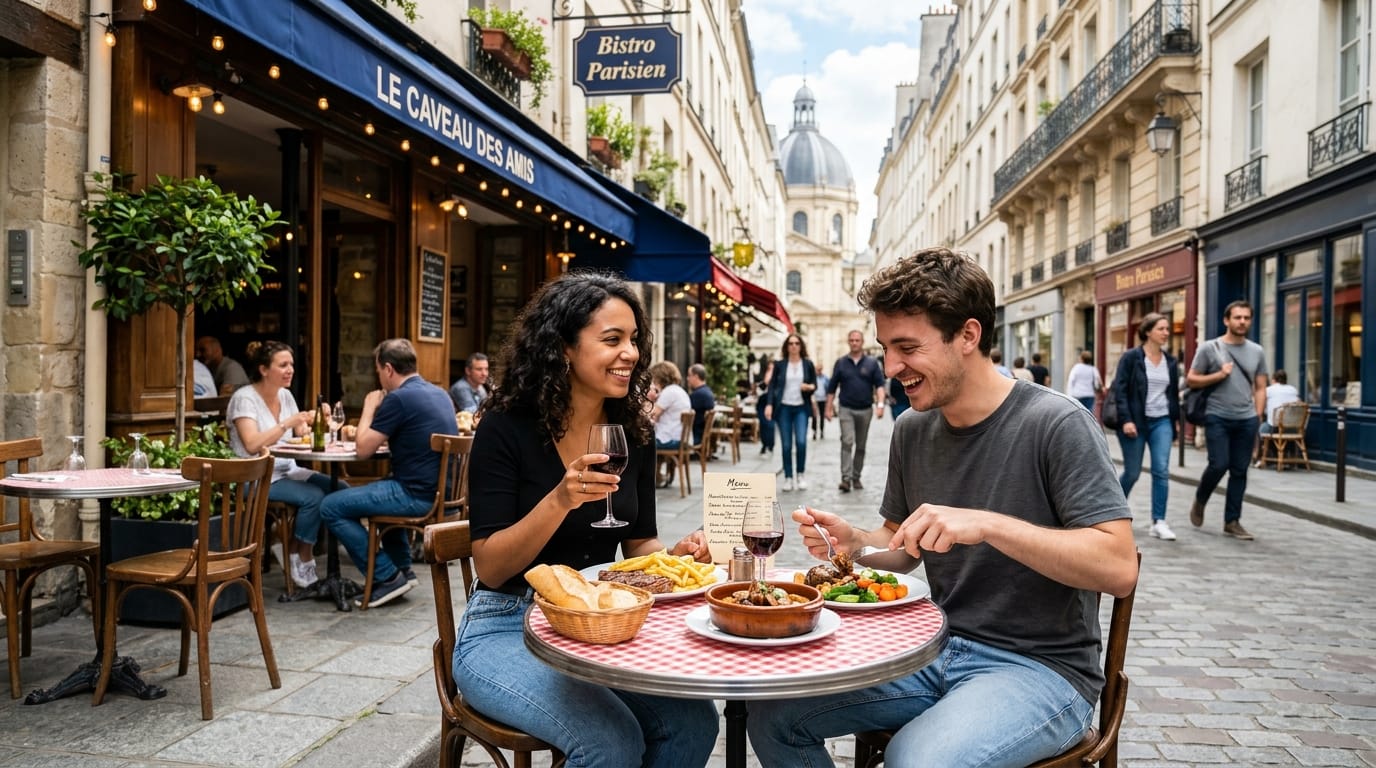
Budget-Friendly Gourmet Experiences in Paris 2026: Eat Like a Local Without Breaking the Bank
Disclosure: This article contains affiliate links. If you book through our links, we may earn a small commission at no extra cost to you.
It was 11am on a Tuesday when I stumbled into a covered market in the 11th arrondissement, chasing the smell of roasted chicken and fresh-baked bread. A woman behind a charcuterie counter handed me a slice of pâté de campagne and a tiny cornichon without being asked. “Goûtez,” she said. Just taste. No sales pitch. No price tag. Just the unselfconscious generosity of someone proud of what they make.
That moment cost me nothing. The lunch that followed — a wedge of tarte flambée, a glass of Alsatian Riesling, an espresso and a square of dark chocolate — cost €11.50. It was one of the best meals of my life.
This is what people miss when they say Paris is too expensive. It’s not that Paris is cheap. It’s that Paris rewards those who eat like Parisians, not like tourists.
- Budget per day (food): €25-40 if you know where to go
- Best neighborhoods: 11th, 12th (Aligre), 3rd (Marais), 20th (Belleville)
- Key tip: Eat your big meal at lunch — most bistros cut prices 30-40% for the formule du midi
- Worst mistake: Eating within 200m of the Eiffel Tower or Notre-Dame
The Truth About Eating Well in Paris on a Budget
According to the Michelin Guide 2026, Paris has 133 starred restaurants — but over 2,000 bistros serve 3-course prix-fixe lunches (formule) for under €15. That’s the number tourists never find, because they’re not looking at the right menus.
The formule du midi is the single most powerful budget hack in Paris. French law doesn’t mandate it, but decades of working-class dining culture have made it universal: entrée + plat + dessert (or any two of the three) for a fixed price, almost always between €12 and €18. The same restaurant that charges €35 per person at dinner serves the same kitchen’s food at lunch for €15.
A 2024 survey by Numbeo found that a mid-range meal for two in Paris averages €60-80 — but savvy locals spend as little as €20 using covered markets and boulangeries. The difference isn’t quality. It’s knowledge.
A few more principles that Paris insiders live by:
- Distance from monuments — Prices drop dramatically as you move away from tourist sites. Two streets behind the Sacré-Cœur, €8 crêpes become €4 crêpes.
- Eat standing up — The same glass of wine costs half as much at the bar (comptoir) as at a table.
- Thursday is market day — Most covered markets have their best selection mid-week.
- Boulangeries as restaurants — A €4 jambon-beurre from a quality bakery beats a €20 café sandwich every time.
These aren’t survival tips for budget travelers. They’re how Parisians actually eat — and why they still believe their city is one of the greatest places on earth to have a meal.
Best Budget Gourmet Markets in Paris 2026
The covered markets (marchés couverts) are where Paris’s gourmet culture becomes genuinely accessible. Here are the three worth making a detour for:
Marché d’Aligre (12th arrondissement)
Open Tuesday-Sunday, 9am-1pm. This is the real deal — chaotic, multilingual, stacked with North African spices, heritage vegetables, and some of the best rotisserie chicken in the city. The indoor halles section (the covered building) houses wine merchants, a cheese cave, and a specialist olive oil vendor. Budget: €10-15 for a full bag of lunch ingredients. Address: Place d’Aligre, 75012.
Marché des Enfants Rouges (3rd arrondissement, Le Marais)
Paris’s oldest covered market, operating since 1628. It’s more of an international food court than a traditional market — Japanese bento, Moroccan couscous, Italian antipasti, and classic French dishes all share the same covered space. This is where Marais locals eat weekday lunches. Budget: €8-14 per person. Address: 39 Rue de Bretagne, 75003.
Marché de Belleville (20th arrondissement)
Open Tuesday and Friday mornings on Boulevard de Belleville. One of the most diverse and undervisited markets in Paris — North African, Cambodian, West African, and French stalls side by side. Prices are consistently 20-30% cheaper than Aligre. The falafel wraps alone are worth the Metro ride.
For context on these neighborhoods, see our guide to Paris’s best neighborhoods — which covers the local character of the 3rd, 11th, and 20th in detail.
Paris Restaurants Under €20 That Taste Like €50
These aren’t “budget options.” They’re some of the best food in Paris at prices that make no logical sense given the quality.
L’Entredgeu (17th) — Formule lunch €16
Classic Parisian bistro with a chef who trained at a two-star restaurant. The pork cheeks braised in red wine change seasonally. Reservations recommended even for lunch.
Le Servan (11th) — Lunch formule €19
Two sisters (one a chef, one front-of-house) running a contemporary French-Asian fusion bistro that gets full every weekday. The natural wine selection is exceptional and affordable. Book 3-5 days ahead.
Chez Aline (11th) — Sandwiches €7-9
A former horse butcher shop (note the original signage) turned into what many consider the best sandwich spot in Paris. The duck rillettes on sourdough with cornichons is legendary.
Mokonuts (11th) — Lunch €14-18
A Lebanese-French café where the bread alone is worth the trip. The lunch menu changes daily based on what’s at market. Cash only.
Café de la Nouvelle Mairie (5th) — Natural wine bar
Right behind the Panthéon (a detail that guarantees tourist overflow won’t find it). A glass of natural Beaujolais goes for €5, and the charcuterie plate with bread is €11. No better afternoon exists in Paris.
Tourism data from Atout France (2025) shows that food experiences are the #1 reason international tourists return to Paris, cited by 71% of repeat visitors. These are the places that create that pull.
The Hidden World of Paris Boulangeries and Pâtisseries
The boulangerie is not a bakery. This distinction matters. A bakery sells bread. A boulangerie is a social institution — the place Parisians stop twice a day (morning and before dinner), where the neighborhood’s character is expressed in the quality of its croissants.
There are roughly 1,200 boulangeries in Paris, and the quality gap between a great one and an average one is enormous. Here’s how to identify the good ones:
- Look for the queue — Parisians do not queue unless it’s worth it
- Check the croissant color — It should be deep amber, not pale gold. Pale = underbuttered, underbaked
- Smell the door — Real butter has a distinct aroma you can’t fake
- Prix affichés — Prices posted on a board indicate an honest operation
Worth finding in 2026:
- Du Pain et des Idées (10th): The most photographed croissants in Paris. Open weekdays only. Get there before 9am.
- Mamiche (9th and 10th): Sourdough country loaves and escargot au chocolat that have a permanent queue.
- Le Bricheton (15th): The least-touristed great boulangerie in Paris. Natural yeast, organic flour, honest prices.
Budget reality: a full breakfast at a great boulangerie — croissant, pain au chocolat, espresso — runs €5-7. That’s how you start a gourmet day in Paris for less than a mediocre hotel breakfast costs.
Wine and Cheese for Less: Where to Shop Like a Parisian
The supermarché is not the enemy. Carrefour and Monoprix stock some excellent regional wines and cheeses, and Parisian food snobs quietly buy their weeknight bottles there. But for a real education in French wine and cheese on a budget, these are the places:
Cave à Vins (independent wine shops):
Every arrondissement has at least one independently owned cave à vins where the patron actually knows what they’re selling. Budget: €7-12 for a very good bottle. Ask for “quelque chose de local autour de 10 euros” and see what happens.
Nicolas chain:
The French equivalent of a reliable chain wine store. House selections under €8 are often excellent. The Côtes du Rhône rouge at €7.50 has been a Paris dinner party staple for years.
Fromageries:
A neighborhood fromagerie sells cheese at roughly the same price as a supermarket but with infinitely better selection, proper aging, and a fromager who will cut you exactly 80 grams of raw-milk Comté and explain where it came from. Budget: €15-20 for a serious cheese board for two.
See our comprehensive guide to French food and regional specialties for a deeper dive into the country’s cheese and wine traditions.
Budget-Friendly Michelin Guide Experiences
Here’s a well-kept secret: the Michelin Guide includes Bib Gourmand designations — restaurants that offer “exceptionally good food at moderate prices.” In Paris 2026, that means three courses for under €40, and often significantly less at lunch.
The Bib Gourmand list in Paris runs to over 80 restaurants. Among the most accessible:
- Septime La Cave (11th): The wine bar arm of two-Michelin-star Septime. Excellent natural wines by the glass, extraordinary bar snacks, no reservation needed. Budget: €20-25/person
- Amarante (2nd): Market-driven French bistro, Bib Gourmand since 2023. Lunch formule €18 including wine. One of the best-value lunches in Paris.
- Le Cadoret (19th): A proper zinc-bar bistro in the 19th — the last truly Parisian neighborhood. Formule €16. The steak frites are extraordinary.
The full Bib Gourmand list is published on the Michelin Guide website and updated annually. It’s the single best free resource for finding quality restaurants at honest prices in Paris.
For Paris accommodation that won’t break the bank, browse budget hotels in Paris — staying in the 11th or 12th arrondissement puts you within walking distance of the best markets and bistros on this list.
Seasonal Paris Food Events in 2026
Paris’s food calendar is surprisingly accessible — many of its best events are free or very low cost:
Fête de la Gastronomie (September 26-28, 2026)
An annual national celebration of French gastronomy with free tastings, market events, and demonstrations across every arrondissement. Many restaurants offer special tasting menus at reduced prices.
Marché International de Rungis — Professional Preview Days
The world’s largest wholesale food market opens its doors for public tours several times a year. Tours start at €30 and include samples. Book months in advance.
Paris Ferme Ton Frigo (February)
A growing anti-waste food festival where chefs across Paris cook from donated surplus ingredients. Some events are free; most are €5-15.
Beaujolais Nouveau Night (Third Thursday of November)
A cultural institution. At midnight on the third Thursday of November, wine bars across Paris release the year’s Beaujolais Nouveau simultaneously. Glasses go for €3-5 all night.
Spring market season (April-June):
The months when Paris produce reaches its peak — asparagus from the Loire, strawberries from the Périgord, new-season lamb. Markets are at their most dramatic and the quality of market lunches is unmatched.
Considering a Paris food tour to get oriented? Find highly-rated options with Paris food tours on Booking.com — many run under €50 and cover market visits, tastings, and insider routes.
Frequently Asked Questions
What is a realistic food budget for Paris per day in 2026?
€25-40 per day is realistic for eating very well — not just adequately. That covers a boulangerie breakfast (€5-7), a formule lunch at a bistro (€12-18), and a market dinner assembled from a fromagerie and wine shop (€10-15). You will eat better on this budget in Paris than on €80 at a tourist restaurant.
Is street food common in Paris?
Paris doesn’t have traditional street food culture the way Southeast Asian cities do, but the boulangerie sandwich, the crêpe stand, and the falafel in the Marais serve the same function. The best €5-7 you’ll spend in Paris is a jambon-beurre from a quality boulangerie eaten on a bench by a canal.
What is a formule du midi?
A set lunch menu, typically 2 or 3 courses at a fixed price, served during lunch hours (12pm-2:30pm). Most Paris bistros offer one, priced between €12 and €20. The formule is how working Parisians eat at sit-down restaurants — and the food quality is identical to the dinner menu from the same kitchen.
Are Paris markets open every day?
Most outdoor markets run 2-3 mornings per week. Covered markets like Marché des Enfants Rouges are open most days (closed Monday). Check each market’s specific schedule — opening times are usually 8am-1:30pm and vendors start packing up by 1pm.
Can you eat well in Paris as a vegetarian on a budget?
Yes, though you’ll need to navigate around a cuisine built on meat. The best options: Middle Eastern and North African restaurants in the 10th and 11th (falafel, mezze, shakshuka), vegan-friendly natural wine bars, and Paris’s growing bistronomie scene, where chefs like Bertrand Grébaut have built vegetable-forward menus at bistro prices.
Which Paris neighborhoods have the best cheap food?
The 11th arrondissement (Canal Saint-Martin, Oberkampf, Bastille) has the highest concentration of quality bistros at honest prices. The 12th (around Aligre market) is the best for market shopping. The 3rd (Marais) has the most diverse international food at mid-range prices. Avoid the 1st, 6th, 7th, and 8th for budget eating.
Start with Marché d’Aligre on a weekday morning, lunch at a Bib Gourmand bistro in the 11th, afternoon wine tasting at an independent cave à vins, and dinner assembled from a fromagerie. That’s a day in Paris that costs €35 and lasts in memory for years.
For where to stay close to the best neighborhoods, compare budget hotels in Paris with good access to the 11th and 12th arrondissements.