Alsace France Travel Guide Wine Route 2026
Disclosure: This article contains affiliate links. When you book through our links, we earn a small commission at no additional cost to you — which helps us keep creating travel content.
Alsace France Travel Guide Wine Route 2026
I didn’t plan to fall in love with Alsace. I had a train to Strasbourg booked, a vague idea of seeing some half-timbered houses, and three days to fill. What I found was something I wasn’t prepared for: a wine route that winds between villages so perfectly preserved they look painted, a culture that belongs to no country completely, and a way of eating and drinking that feels like the best argument for slowing down that Europe has to offer. This is the Alsace I want to tell you about — not a checklist, but a discovery.
The Train In: Why Alsace Feels Like a Different Country
The TGV from Paris Gare de l’Est to Strasbourg takes about 1 hour 45 minutes and costs roughly €25-60 depending on when you book. That journey doesn’t just cover geography; it spans centuries of cultural tug-of-war. Alsace has been French, German, and something entirely its own at different points throughout history — ceded to Germany after the Franco-Prussian War of 1870, returned to France after World War I, annexed again between 1940-1944, and returned to France in 1945.
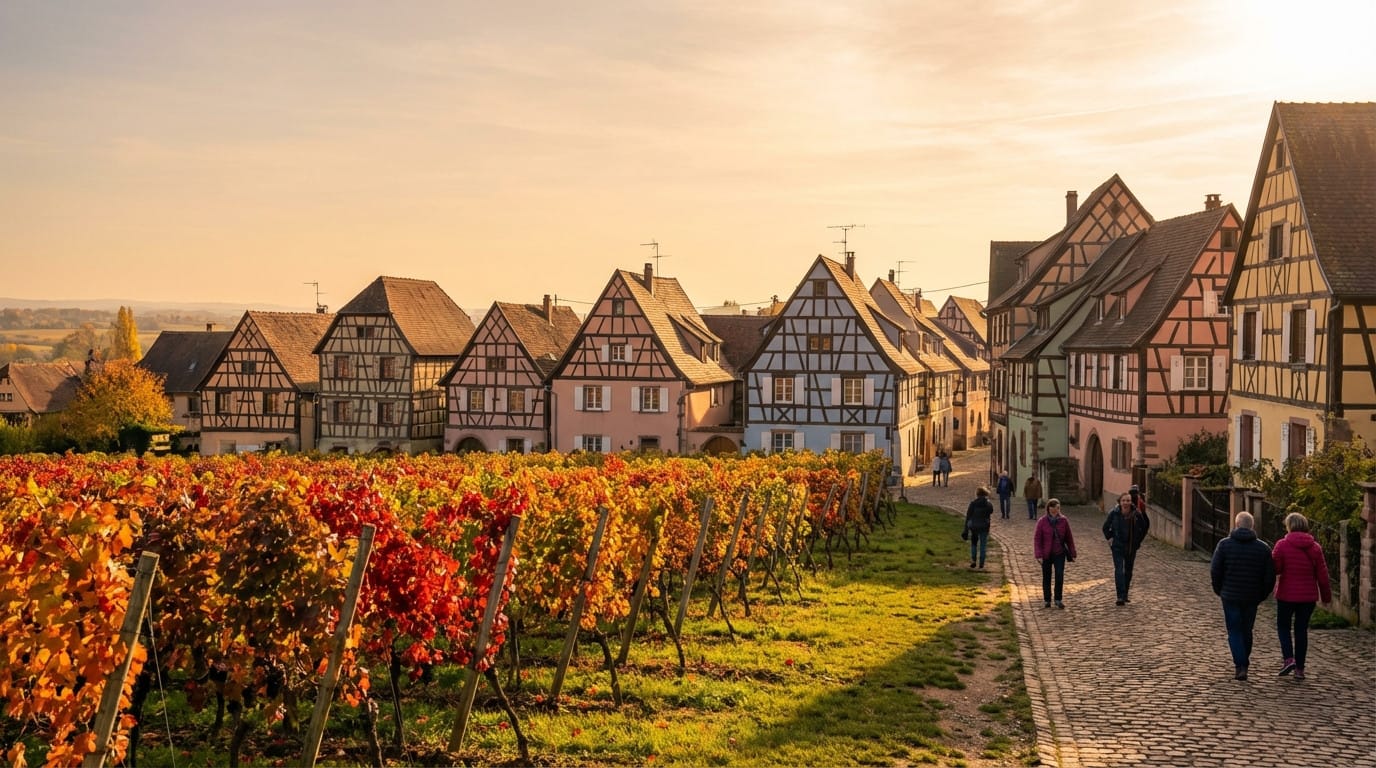
You can see that history written right into the architecture. Think half-timbered Fachwerkhäuser (those German-style framework houses) leaning over narrow, cobblestone streets, flowers spilling from every window box. You’ll find restaurants serving hearty choucroute garnie (that’s sauerkraut with pork, by the way) right alongside delicate tarte flambée and crisp Riesling in those iconic green-stemmed glasses. Signs? They’re often in both French and the local Alsatian dialect. Honestly, the whole region feels like it exists in its own little sovereignty.
Alsace Tourisme says the region welcomes over 10 million visitors a year, which, let’s be real, makes it one of France’s most-visited spots outside Paris. But here’s the thing: spread across 170km of wine road and 120 charming villages, it rarely feels crowded, unless you hit those peak summer weeks.
Strasbourg: The Starting Point
Most travelers arrive in Strasbourg first, and rightly so. Strasbourg, the capital of Alsace, is easily one of France’s most underrated cities. It’s home to the European Parliament, sure, but also a UNESCO World Heritage medieval center and La Petite France, that old tanners’ district where canals perfectly reflect the country’s most picturesque half-timbered skyline.
You really need to give Strasbourg at least one full day. The Cathédrale Notre-Dame, which took nearly 300 years to build (1015-1439), is one of Europe’s finest examples of Gothic architecture. And trust me, the astronomical clock inside is totally worth the queue. Then there’s the Musée d’Alsace; it traces the region’s folk history, showcasing reconstructed interiors and traditional costumes. Oh, and the covered market, Les Halles? That’s where you’ll snag your first bretzel and, more importantly, your first glass of Crémant d’Alsace. It’s sparkling wine that tastes just like Champagne but costs a third of the price. Bargain!
Hungry in Strasbourg? Au Crocodile is the Michelin-starred spot, if that’s your thing. But for the real deal, you can’t beat Winstub Le Clou. It’s a traditional Alsatian tavern (they call ’em winstubs) where you’ll find long communal tables, choucroute for two, and a bottle of Pinot Gris that costs €18 and, let’s be honest, will disappear in twenty minutes flat.
The Route des Vins: Village by Village
From Strasbourg, head south. The Alsace Wine Route officially kicks off at Marlenheim, about 20km west of Strasbourg. But honestly, most of the real magic happens in that central section, between Obernai and Colmar. Here’s how I’d tackle it:
Obernai: The First Stop South
Obernai is a market town, sure — it’s busier than the tiny villages, but genuinely beautiful. You’ll find a 15th-century corn market, a medieval rampart tower, and a Saturday morning market that just overflows the central square with Alsatian produce, charcuterie, and foie gras, arriving by the kilo from nearby farms. The winstubs here? They’re excellent. Grab lunch, stock up on some cheese, and then you’re off.
Andlau and the Hidden Valley
Between Obernai and Ribeauvillé, there’s a secondary road leading into the Andlau valley that most visitors just skip right over. Don’t you dare skip it! Andlau’s a tiny village, but it’s got a Romanesque abbey church packed with some of the finest Romanesque carvings in Alsace. Think bears carved into the architrave, vines, eagles, and biblical scenes, all done in that rough, vital 12th-century style. A few kilometers south, the Domaine Rolly-Gassmann makes Rieslings that wine critics have actually compared favorably with Grand Cru producers — at half the price! So, stop. Taste. Buy a case to ship home. You won’t regret it.
Ribeauvillé: Three Castles Above
Ribeauvillé is the wine route at its most dramatic. Seriously, three ruined medieval châteaux — Saint-Ulrich, Girsberg, and Haut-Ribeaupierre — sit right on the ridge above the village. You can spot them from every street in town! The hike up to Saint-Ulrich takes about 45 minutes from the village, and the views across the Rhine plain to Germany’s Black Forest are absolutely incredible. Totally worth every single step.
This village? It’s famous for its Riesling. Trimbach, one of Alsace’s most prestigious estates, is based right here — their Clos Sainte Hune Riesling is actually one of the most collectible dry white wines globally. If you want accessible, great Riesling, just pop into Jean Sipp or Louis Sipp for tastings; they don’t require a reservation and won’t cost you a thing.
Riquewihr: The Jewel
I’d been told Riquewihr was touristy, and yeah, that’s partly true — it probably draws more visitors per square meter than almost anywhere else on the route. But honestly, standing inside its 16th-century ramparts on a Tuesday morning in late September, before the tour buses rolled in, I totally understood why: Riquewihr is almost unbearably beautiful. Not a single building from after 1600 messes up the streetscape. Just painted facades, beautifully carved wooden signs, and geraniums spilling from every window. What a sight! The village produces some of the finest Riesling in Alsace, too, under the Schoenenbourg and Sporen Grand Cru classifications.
Go early. Stay for maybe two hours. Grab a tarte flambée at one of the winstubs on the main street. And then, seriously, leave before noon.
Kaysersberg: Alsace’s Soul Village
If Riquewihr is the postcard, Kaysersberg is the soul. It’s the birthplace of Albert Schweitzer (his family home’s now a museum, by the way), and Kaysersberg boasts a 15th-century fortified bridge, a ruined castle, and a winding main street that feels way less performative than Riquewihr. Why? Because people actually live here! And the Christmas market in December? It’s easily one of the most atmospheric in all of France.
The wine you absolutely need to drink here is Gewurztraminer. The Weinbach estate, one of Alsace’s legendary producers, is based right in Kaysersberg, and their late-harvest Vendanges Tardives wines are, in my opinion, some of the most extraordinary expressions of that grape anywhere on the planet. Just make sure to book a tasting in advance.
Colmar: The Heart of It All
Colmar is where most travelers base themselves, and after driving the route, I understood why: it’s a proper town (population 67,000) with excellent restaurants, a world-class art museum, and easy access to the wine route’s central section in every direction.
The Unterlinden Museum? It houses the Isenheim Altarpiece by Matthias Grünewald — honestly, one of the most powerful works of religious art you’ll ever see. It was painted in 1515 for a monastery hospital, and trust me, it will absolutely stop you in your tracks. Give yourself at least two hours there. La Petite Venise (that’s Little Venice) in Colmar is definitely the tourist hot spot — think canal walks, flower-draped houses, and boat tours. And you know what? It’s legitimately beautiful. Don’t be a snob about it! The Marché Couvert (covered market) nearby is where the locals actually shop, and I still dream about the casual lunch I had there: a counter serving Alsatian tarte flambée right next to a Munster cheese stall. Perfection!
Looking for a place to stay in Colmar? You’ve got options, from boutique hotels right in the historic center to charming chambres d’hôtes in the surrounding wine villages. You’ll want to book through Booking.com for the widest selection, no matter your budget. And if you’re keen on guided tours of the wine route or Colmar’s historic center, GetYourGuide’s Alsace tours come highly recommended, offering excellent day trips with local experts.
Where to Stay: A Practical Guide
Alsace has accommodation for every budget:
- Colmar center (€90-180/night): In the historic center, you could try La Maison des Têtes (a 5-star gem in a historic building) or Hotel Le Marechal (with those lovely canal views in La Petite Venise). If you’re on a tighter budget, Ibis Colmar Horbourg is a solid pick.
- Wine village immersion (€60-120/night): For a truly memorable experience, go for a chambre d’hôte (that’s a B&B) in villages like Riquewihr, Ribeauvillé, or Eguisheim. Many hosts even produce their own wine, which is a huge bonus!
- Luxury (€200+/night): If you’re looking to splurge, check out Château de l’Ile near Strasbourg, or even Les Sources de Caudalie, which is a Bordeaux-style wine resort.
You’ll want to book at least 2-3 months ahead, especially if you’re coming for the September-October harvest season. And for the Christmas market period (late November-December)? Those places book out even earlier, so plan way ahead!
Practical Tips for the Alsace Wine Route in 2026
- Getting there: Take the TGV from Paris Gare de l’Est to Strasbourg; it’s just 1h45. If you’re coming from London, Eurostar gets you to Paris, then you connect. Plus, the Strasbourg-Basel-Mulhouse airport serves the region too.
- Getting around: A car gives you maximum flexibility, no doubt. But cycling is also fantastic — the route’s pretty flat between villages and super well-marked. You can even rent e-bikes in Colmar and Strasbourg.
- Language: You’ll hear French everywhere, of course. Some older locals speak the Alsatian dialect, and German is widely understood. English? It’s usually enough at most tourist sites and hotels.
- Money: Plan to budget around €80-120 a day for accommodation, meals, and wine tastings. Most tastings are either free or just €5-15. And if you’re eyeing Grand Cru bottles, they typically start at €25.
- Best harvest events: Don’t miss the Vendanges à Riquewihr in October, the Marché de Noël de Strasbourg from late November through December, or the Fête des Vins de Ribeauvillé in July-August.
For more France travel inspiration, why not check out our guides to 25 hiking trails in France and the 7 best neighborhoods in Paris? Our Paris travel guide with insider secrets is also a great one to bookmark before your trip.
Alsace was the France I wasn’t expecting to love most. The wine, the architecture, the food — but most of all the particular character of a place that has absorbed two cultures and become something irreducibly its own. Come in autumn. Come with an empty car and enough room for wine. Come without too rigid an itinerary. Let the route unfold at village speed.
Frequently Asked Questions
When is the best time to visit Alsace for the wine route?
September and October are definitely the best months. You get harvest season, golden vineyards, Vendanges festivals, and that incredible autumn light. Spring (April-May) is also gorgeous, plus you’ll find smaller crowds.
How long is the Alsace Wine Route?
The Route des Vins d’Alsace stretches 170 kilometers from Marlenheim all the way to Thann. Most visitors, though, tend to cover the best central section — Obernai to Colmar — which takes about 3-4 days by car or bike.
What wines is Alsace known for?
Alsace exclusively produces white wines and rosé. The main varieties you’ll find are Riesling (which is totally their signature), Gewurztraminer, Pinot Gris, and Muscat. Oh, and Crémant d’Alsace? That’s their excellent local sparkling wine. What’s cool is that wines are labeled by grape variety, not appellation.
Is Alsace easy to visit without a car?
Mostly, yes! The TGV connects Strasbourg and Colmar directly with Paris. Regional trains and buses cover the main villages, and cycling is super popular too. But for ultimate flexibility and to hit those off-the-main-stop gems, renting a car for 2-3 days is definitely worth it.
Where should I stay in Alsace?
Colmar is your ideal base, hands down — it’s central, beautiful, and really well-connected. Eguisheim offers a more authentic village immersion, if that’s what you’re after. And for the most memorable experience? Try a wine village chambre d’hôte in Ribeauvillé or Kaysersberg.
What is the Christmas market season like in Alsace?
Alsace’s Christmas markets? They’re easily among Europe’s finest. Strasbourg’s Christkindelsmärik actually dates all the way back to 1570! Colmar, Kaysersberg, and Eguisheim also host stunning markets from late November right through December. Just remember to book your accommodation months in advance for this period, or you’ll miss out!