7 Best Neighborhoods in Paris You Must Visit: Complete Insider Guide 2026
Last Updated: March 2026
Paris has 20 arrondissements, but honestly, only a handful truly deliver the full experience: you know, the iconic architecture, the legendary food, that genuine Parisian vibe, and those unique moments you just won’t stumble upon in any guidebook. These are the 7 neighborhoods that absolutely belong on every serious Paris itinerary — and I’m giving you the honest, specific advice most travel articles conveniently skip.
Related France Guides
Table of Contents
- Why Neighborhoods Define the Paris Experience
- What Most Paris Guides Get Wrong About Neighborhoods
- The 7 Best Paris Neighborhoods: Insider Breakdown
- Practical Planning: Getting Around, Costs, Timing
- Hidden Gems Within Each Neighborhood
- ETIAS & Entry Requirements for 2026
- Frequently Asked Questions
I’ve actually called Paris home for fifteen years, living across three different arrondissements. I’ve guided American, British, and Australian friends through the city dozens of times. The question I hear most often? “Where should we *actually* spend our time?” This, my friends, is my honest answer.
Why Neighborhoods Define the Paris Experience
Paris isn’t just one city — it’s twenty distinct villages, each with its own character, food culture, architecture, and social identity, all stitched together under one famous name. What’s the real difference between the 6th and the 20th? It’s like night and day: one’s an academic, bourgeois world of bookshops and wine bars, while the other’s a diverse, working-class spot full of incredible street art and €3 coffees.
France’s national tourism body, Atout France, reports that 82% of repeat Paris visitors say neighborhood exploration is their main activity on return trips. Once they’ve seen the monuments, they want to experience the city as it truly lives.
According to the City of Paris’s 2024 tourism report, visitor satisfaction scores are highest for “authentic local experiences” (a whopping +18% versus 2019) and lowest for “crowds at major sites” (-23%). The data just confirms what experienced travelers already know: the best Paris is definitely off the monument circuit. Why stick to the crowded spots when you can find the real magic?
What Most Paris Guides Get Wrong About Neighborhoods
Every single Paris guide recommends Saint-Germain-des-Prés as the intellectual heart of the city. Sure, it *was* — back in 1960. Today? It’s a luxury shopping district where Café de Flore charges €8.50 for an espresso, and honestly, the only writers you’ll find there are travel bloggers churning out their “authentic Paris” articles. It’s just not the same.
The Marais often gets recommended as a non-touristy alternative to the Right Bank monumental circuit. But let’s be real, the Marais now has more tourists per square meter than almost anywhere else in Paris. It’s undeniably beautiful, don’t get me wrong — but non-touristy it is not. If you’re looking for where the real neighborhood still exists, you’ll find it above the tourist tide line in Le Marais and Le Haut Marais (the northern section).
Here’s the honest framework: the Seine splits the city, dividing the Left Bank (traditionally bourgeois, literary, university-heavy) from the Right Bank (historically commercial, working-class in the east, aristocratic in the west). What I’ve found is that the best neighborhoods in 2026 are actually in the eastern Right Bank, where gentrification isn’t quite complete and authenticity still thrives.
The 7 Best Paris Neighborhoods: Insider Breakdown
1. Le Marais (3rd & 4th) — Iconic, Complex, Worth It
Metro: Saint-Paul (line 1), Rambuteau (line 11) | Best for: Architecture, museums, LGBTQ+ scene, Sunday shopping
The Marais is genuinely remarkable. It’s a medieval neighborhood that miraculously survived Haussmann’s 19th-century rebuilding and kept its stunning 17th-century hôtels particuliers (private mansions) intact. The Place des Vosges (Paris’s oldest planned square, built 1612) is one of Europe’s finest architectural spaces; it’s often less crowded if you go at 8 am or after 6 pm. Trust me on that.
The Musée Picasso (5 Rue de Thorigny, €14) and Musée Carnavalet (the history of Paris, with a free permanent collection) are both extraordinary and usually less swamped than the Louvre. And you absolutely have to check out the Jewish Quarter on Rue des Rosiers — grab a falafel from L’As du Fallafel (34 Rue des Rosiers, €7, queue outside, but totally worth it). It’s still the best fast food in Paris, hands down.
On Sunday, when most Paris shops are closed, Rue de Bretagne and the Marais boutiques open up, making it the best Sunday shopping neighborhood in the city. It’s a lifesaver!
2. Saint-Germain-des-Prés (6th) — For the Architecture and Bookshops
Metro: Saint-Germain-des-Prés (line 4), Odéon (lines 4, 10) | Best for: Architecture, Shakespeare & Company, Luxembourg Gardens
Don’t go to Saint-Germain expecting the old café intellectual scene — it’s simply gone. Instead, go for the incredible architecture (some of Paris’s finest hôtels particuliers, the magnificent Église Saint-Sulpice), the Shakespeare & Company bookshop (37 Rue de la Bûcherie — it’s genuinely magical, perfect for stocking up on English-language books), and of course, the Jardin du Luxembourg.
The Luxembourg gardens (free entry) stretch over 23 hectares and are the most used park in central Paris. You’ll see locals bringing their children on weekends, students studying on benches, and retirees playing pétanque. What’s a perfect morning look like? A coffee at a non-famous café on Rue de Buci, then 2 hours just soaking it all in at Luxembourg.
3. Montmartre (18th, South) — Go Early, Go Right
Metro: Abbesses (line 12) | Best for: Dawn views, Sacré-Cœur, vineyard, Place du Tertre (briefly)
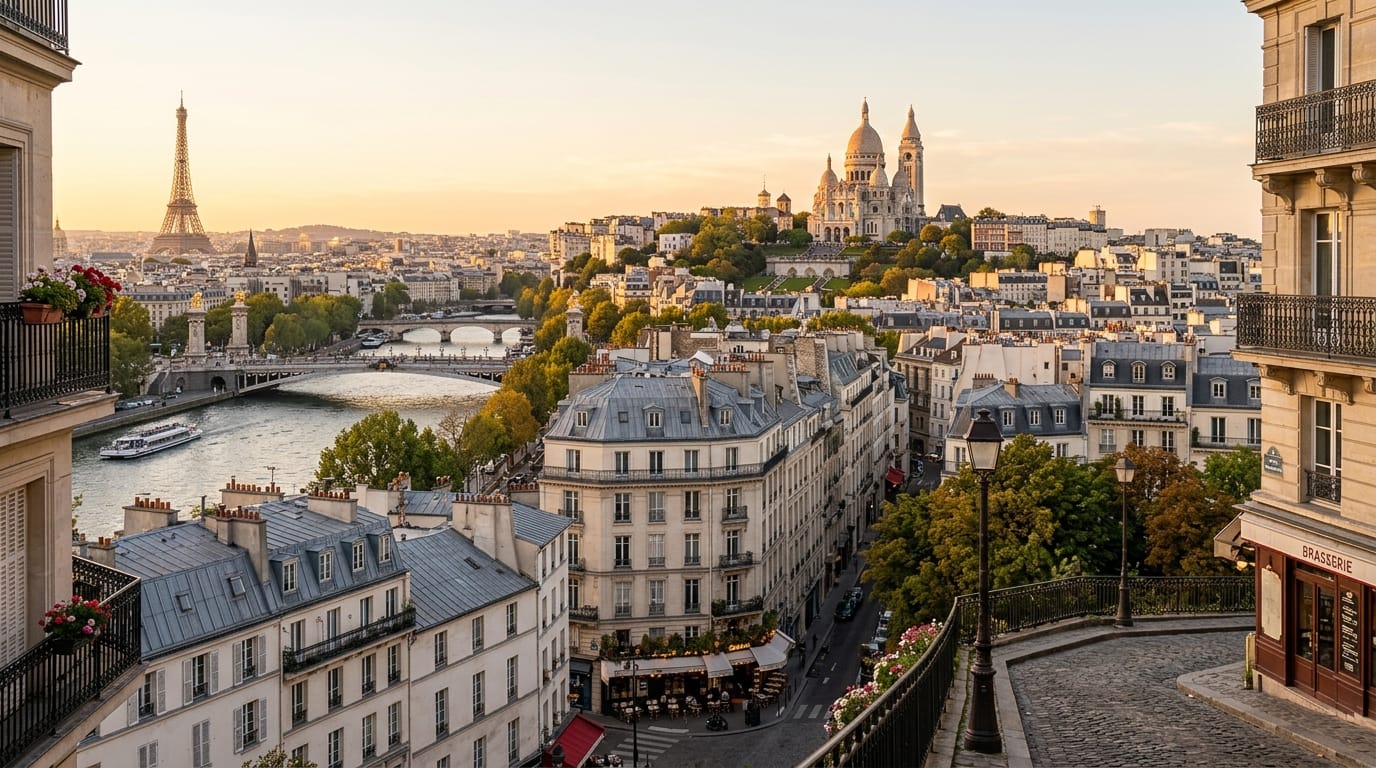
Montmartre gets absolutely swamped by tourists — but only after 10 am. My advice? Arrive at dawn (especially in summer when sunrise is before 6 am) and you’ll have the Butte almost entirely to yourself. That view from the steps of Sacré-Cœur at first light? It’s genuinely one of the greatest views on earth, no exaggeration.
The Clos Montmartre vineyard (14 Rue des Saules) is a real, tiny vineyard right within Paris city limits, producing about 1,500 bottles annually. It’s cool, right? Just walk past it on a weekday morning. The streets around Rue Lepic (below the hill) still have a genuine neighborhood character — think Rue Lepic’s market vendors, the café at the top where Amélie was filmed, and that hardware shop that looks like it hasn’t changed since 1975.
4. Belleville (20th) — Street Art, Diversity, Real Paris Prices
Metro: Belleville (lines 2, 11) or Pyrénées (line 11) | Best for: Street art, Chinese food, panoramic views, Parc de Belleville
Belleville is where Édith Piaf was born (there’s a plaque marking the corner of Rue de Belleville where locals claim she arrived mid-delivery!). Today, it’s one of Paris’s most multicultural neighborhoods — Chinese-French, North African, West African, and French communities all overlapping in a truly vibrant mix. It’s fantastic.
The Parc de Belleville (free, open daily) climbs a hill, offering a panoramic terrace with what I think is the best free view over Paris — even better than Sacré-Cœur because it faces west, directly toward the Eiffel Tower. Plus, Belleville’s street art circuit (especially Rue Denoyez, a 100-meter legal graffiti corridor) is one of Europe’s finest open-air art spaces. You won’t want to miss it.
5. Canal Saint-Martin (10th) — The Postcard-Perfect Neighborhood
Metro: République (lines 3, 5, 8, 9, 11) or Jacques Bonsergent (line 5) | Best for: Cafés, boutiques, Sunday picnics, Amélie filming locations
The Canal Saint-Martin’s iron footbridges, plane tree canopy, and lock system pop up in countless Paris films for a reason: they’re genuinely beautiful in real life too. The neighborhood’s been “discovered,” but it hasn’t quite become tourist-saturated yet. It’s that sweet spot where quality coffee shops and independent boutiques thrive right alongside local hardware stores and pharmacies. It’s just lovely.
Hôtel du Nord (102 Quai de Jemmapes) is a working café-restaurant famous from Marcel Carné’s 1938 film. A coffee here costs €2.80, and the terrace overlooking the canal? Exceptional. Seriously, walk north from République along both canal banks (Quai de Valmy on the west, Quai de Jemmapes on the east) — that’s 30 minutes of perfect Paris right there.
6. Latin Quarter (5th) — For Books, History, and Student Energy
Metro: Maubert-Mutualité (line 10), Cluny-La Sorbonne (line 10) | Best for: History, bookshops, Panthéon, student brasseries
The Latin Quarter gets its name from the Latin that Sorbonne scholars spoke here for centuries. Yes, it’s touristy — but authentically so, because French students and academics still actually live and work here. The Panthéon (€13 entry) is extraordinary and rarely crowded mid-week; Foucault’s Pendulum hangs in the nave, which is pretty cool.
Rue Mouffetard is, in my opinion, the best street market experience in central Paris. It’s a steep cobblestone street packed with food vendors, cheese stalls, and €12 lunch menus available Tuesday through Sunday mornings. You can get a complete market breakfast (coffee, croissant, fruit) for just €5–7. What a deal!
7. Bastille / Oberkampf (11th) — Where Young Paris Actually Lives
Metro: Bastille (lines 1, 5, 8) or Oberkampf (lines 5, 9) | Best for: Restaurant scene, Sunday market, nightlife, real neighborhood feel
The 11th is the neighborhood I recommend above all others to visitors who truly want a local Paris experience. It’s central, it’s safe, and it’s absolutely packed with excellent restaurants at non-tourist prices. Plus, it boasts the best Sunday market in the city (Marché de la Bastille, Boulevard Richard-Lenoir, 7 am–2 pm). You can’t beat it.
The concentration of restaurants around Rue de Charonne, Rue Oberkampf, and Avenue Parmentier is honestly the most exciting in Paris for the price. Imagine dinner with wine for two at a genuine neo-bistro: that’ll run you €70–100. The equivalent experience in Saint-Germain? You’re looking at €160–220. The 11th really delivers more per euro than anywhere else in the city, in my experience.
Practical Planning: Getting Around, Costs, Timing
Metro: The Paris metro runs from 5:30 am–1:15 am (or 2:15 am Fri/Sat). A single ticket costs €2.10. If you’re planning to use it a lot, a daily pass (Navigo Liberté+) is €8.65. Good news: the best neighborhoods in this guide are all served by lines 1, 4, 5, 9, 11 — basically, the central east-west and north-south spines.
Walking: Paris is incredibly walkable, which is one of its charms! Central Paris (all 7 neighborhoods I’ve mentioned) fits within a 5km-diameter circle. A brisk walk from Bastille to the Marais takes about 15 minutes. From Canal Saint-Martin to Belleville? That’s 20 minutes uphill. Definitely download Maps.me with an offline Paris map; it’s a lifesaver.
Timing: You really want to avoid Paris in August; half the city’s on vacation, and lots of restaurants are closed. In my opinion, the best months are May–June and September–October. December can be cold, but it’s super atmospheric with the Christmas markets and lights on the Champs-Élysées, plus there are fewer tourists than in summer.
Hidden Gems Within Each Neighborhood
Marais: You’ve got to check out The Musée de la Chasse et de la Nature (62 Rue des Archives, €10). It’s a hunting and nature museum housed in a gorgeous 17th-century hôtel particulier. Think taxidermy, contemporary art, medieval hunting horns, and almost no queue. It’s one of Paris’s best small museums, trust me.
Saint-Germain: The Église Saint-Sulpice (free entry) boasts a magnificent organ, and on sunny days, a sundial gnomon casts a line of light across the transept floor. Fun fact: that’s what inspired *The Da Vinci Code*. The real gnomon has nothing to do with that story, of course, but it’s still spectacular to see.
Canal Saint-Martin: Point Éphémère (200 Quai de Valmy) is a cool cultural center in a former warehouse. They host live music, exhibitions, and have a fantastic canal-facing terrace. Entry’s free for most events. Plus, they serve the best €6 glass of natural wine in Paris, in my humble opinion.
Bastille: Don’t miss the Viaduc des Arts (Avenue Daumesnil, 12th, starts at Bastille). It’s a series of artists’ studios and craftspeople’s workshops set up in the arches of a 19th-century railway viaduct, with a 4.5km elevated walking park right above it. It’s free, it’s extraordinary, and almost nobody goes. Why not?
ETIAS & Entry Requirements for 2026
Non-EU visitors (think Americans, Canadians, Australians, and British citizens) will need ETIAS authorization to enter France starting from 2026. It costs €7, and is valid for 3 years. You need to apply via the official EU ETIAS portal only — third-party sites can charge you up to €60 for the exact same process, which is just a waste of money.
Processing is usually automatic, taking mere minutes, but occasionally it can take up to 96 hours for a manual review. So, apply before you book your flights, just to be safe! Good to know: ETIAS covers all Schengen Area countries, so if you’re combining a Paris trip with Amsterdam or Barcelona, it’s all covered under one application.
Frequently Asked Questions
Which Paris neighborhood is best for first-time visitors?
If you’re a first-timer, I’d suggest staying in the 11th (Oberkampf/Bastille area) or the 10th (Canal Saint-Martin). These offer the best combination of great location, reasonable prices, and an authentic Parisian atmosphere. Both are well-connected by metro, feel safe, and have fantastic dining and café options for every budget.
What is the most beautiful neighborhood in Paris?
Architecturally, the Marais is simply unmatched — with its 17th-century mansions, the stunning Place des Vosges, and some of Paris’s oldest streets. For natural beauty, the Canal Saint-Martin’s iron bridges and plane-tree canopy are truly extraordinary. But for sheer dramatic setting? Montmartre at dawn from the Sacré-Cœur steps is hard to beat.
Which Paris neighborhood has the best restaurants?
Hands down, the 11th arrondissement (especially around Oberkampf and Rue de Charonne) has the highest concentration of excellent, fairly priced restaurants. With places like Septime, Clamato, and dozens of fantastic neo-bistros, this is, in my opinion, the city’s best dining neighborhood for your money. The 10th around Canal Saint-Martin comes in a close second.
How many days do you need to explore Paris neighborhoods properly?
You’ll need a minimum of 5 days to truly cover the 7 neighborhoods I’ve listed above in a meaningful way. Ideally, I’d say 7–10 days. If you only have 3 days, here’s how I’d prioritize: Marais + Latin Quarter (Day 1), Montmartre at dawn + Canal Saint-Martin in the afternoon (Day 2), and Bastille market + Belleville street art (Day 3).
Are Paris neighborhoods walkable between each other?
Absolutely! Central Paris is remarkably compact. Walking from the Marais to Bastille takes just 15 minutes. Canal Saint-Martin to Belleville? That’s 20 minutes (a bit uphill!). And from the Latin Quarter to Saint-Germain, it’s only 10 minutes across the Seine. While the metro is faster, walking between neighborhoods truly reveals the city’s transitions and those fantastic hidden corners.
What is the safest Paris neighborhood for tourists?
Honestly, all 7 neighborhoods I’ve listed are safe for tourists. Paris overall has pretty low violent crime rates. Just remember to take standard urban precautions (like watching out for pickpockets on the metro and at popular tourist sites). If you’re looking for the safest area for a casual late-night stroll, I’d say the Marais, followed closely by Saint-Germain and Canal Saint-Martin.
—
Marie Dupont | Paris-based Travel Writer & France Expert | Lived in France 15 years. Marie has lived in the 11th, 20th, and 10th arrondissements and navigated Paris’s neighborhoods for American and British publications since 2011.